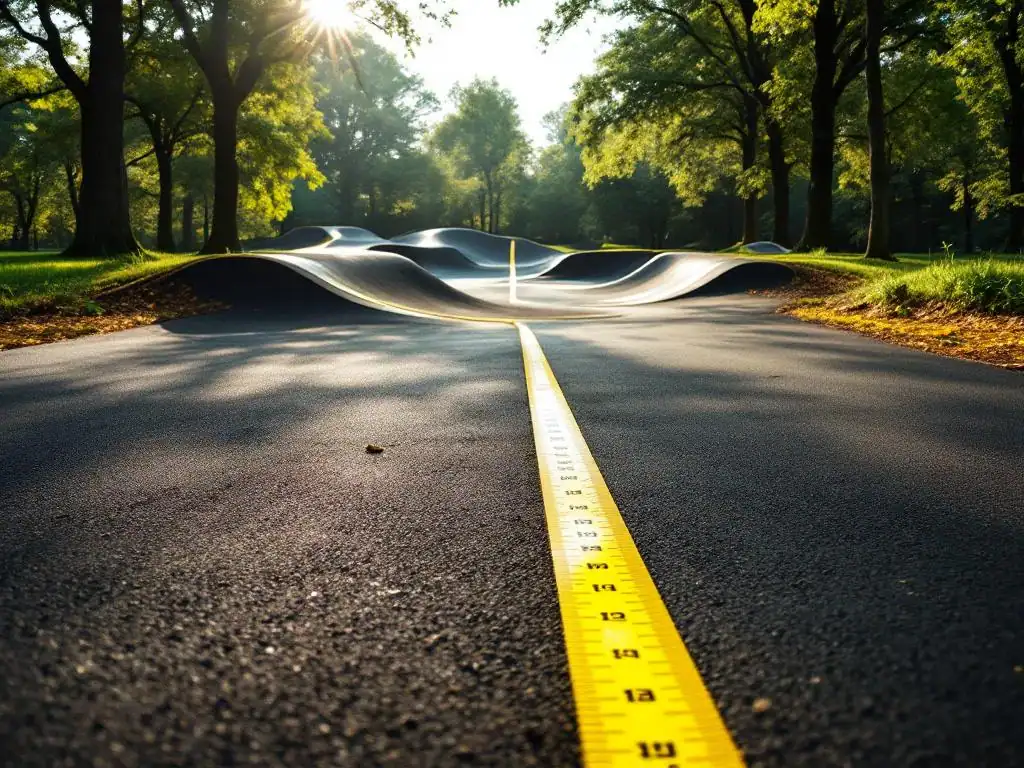
A pump track has at least 400-600 square meters necessary for a functional layout. For smaller areas, compact designs are possible starting at 300 square meters, while larger projects can cover up to 2000 square meters. The exact space depends on your target audience, budget, and desired capacity.
What are the minimum dimensions for a pump track?
The absolute minimum space for a functional pump track is around 300-400 square metersOn such a terrain, you can create a compact course suitable for beginners and children. These smaller pump tracks typically have a simpler layout with fewer technical elements, but still offer the full pump track experience.
For a comfortable pump track suitable for all ages, you'll need at least 500-600 square meters. This provides ample space for a varied route with varying levels of difficulty. Even in limited terrain, we can devise creative solutions by cleverly utilizing elevation changes and the natural contours of the terrain.
Compact designs work well for schoolyards, small parks, or as part of a larger playground. The most important thing is that the track runs smoothly and is safe for all users, regardless of size.
How much space do you need for different user groups?
For toddlers and young children For ages 2-8, an area of 300-500 square meters is sufficient. These pump tracks have lower hills, wider curves, and gentler inclines. The focus is on safe learning and fun with balance bikes and small children's bikes.
Mixed age groups (ages 4-16) require more space: 600-1000 square meters. This is the most popular option, as a single track is suitable for children on balance bikes to teenagers on BMX bikes. The track will have different lines and difficulty levels.
Advanced riders and young adults Requires 800-1500 square meters of challenging pump tracks with technical elements. These tracks have steeper hills, sharper turns, and more complex layouts that challenge skilled riders.
Most municipalities opt for the mixed variant, because it has the largest reach. One asphalt pump track then serves the entire neighborhood, from toddler to adult.
What factors determine the final size of your pump track?
Budget is often the most important factor. A smaller pump track costs less, but you often get more bang for your buck per square meter with larger projects. It's wise to consider the cost per potential user over the track's lifespan.
User capacity also plays a major role. A busy neighborhood needs more space than a small town. With many simultaneous users, wider lanes and multiple routes are important for safety and enjoyment.
Accessibility Requires additional space for paths, parking, and possibly seating for parents. Wheelchair accessibility requires wider entrances and adapted ramps.
Safety zones The area around the pump track also takes up space. You need at least 2-3 meters of clear space around the track for safety and maintenance.
Future expansion opportunities are a smart move to consider in your planning. You might start small, but reserve space for later expansion if the project proves successful. View our completed projects to see how other municipalities have solved this.
| Area size | Suitable for | Capacity | Features |
|---|---|---|---|
| 300-500 m² | Young children | 5-8 children | Simple layout, low hills |
| 600-1000 m² | All ages | 10-15 users | Multiple routes, varied levels |
| 1000-1500 m² | Advanced | 15-20 users | Technical elements, challenging |
What is the ideal shape and location for a pump track?
Rectangular or oval areas They work best for pump tracks. A ratio of about 2:3 or 3:4 provides ample space for a nice, round course. Very narrow or elongated courses limit design possibilities and make the course less interesting.
Orientation is important for comfort. Try to position the track's main direction so that riders don't constantly have to look directly into the sun. A north-south orientation often works well in the Netherlands.
Drainage Requires a slight slope or good drainage. Pump tracks must dry quickly after rain. Low-lying areas where water stagnates are less suitable without drainage adjustments.
Directions Practicality is important for maintenance. Maintenance vehicles must be able to access the pump track for periodic maintenance and any necessary repairs.
The location also influences the user experience. A spot with natural shelter from the wind is more pleasant than a completely open area. Proximity to other amenities, such as playgrounds or sports fields, can make the pump track even more appealing.
How Velosolutions helps with space planning for your pump track
We perform a thorough terrain analysis To maximize the potential of your available space, our team considers not only dimensions but also soil conditions, drainage, accessibility, and environmental factors that influence the design.
Custom designs Within the available space, we specialize in pumping. Whether you have 400 or 1400 square meters, we'll create a pump track that maximizes every square meter and perfectly suits your target audience and budget.
Our complete process includes:
- Free site visit and feasibility advice
- 3D design with various options within your budget
- Assistance with permit applications and WAS certification
- Professional installation by experienced specialists
- Inspection and certificate according to NEN-EN 14974
- Maintenance plan for optimal lifespan
We guide you through the entire process from the initial idea to the official opening. Read more about us and discover why more than 100 municipalities and recreation parks have chosen our expertise. Request a no-obligation consultation and let's see together what is possible on your site.