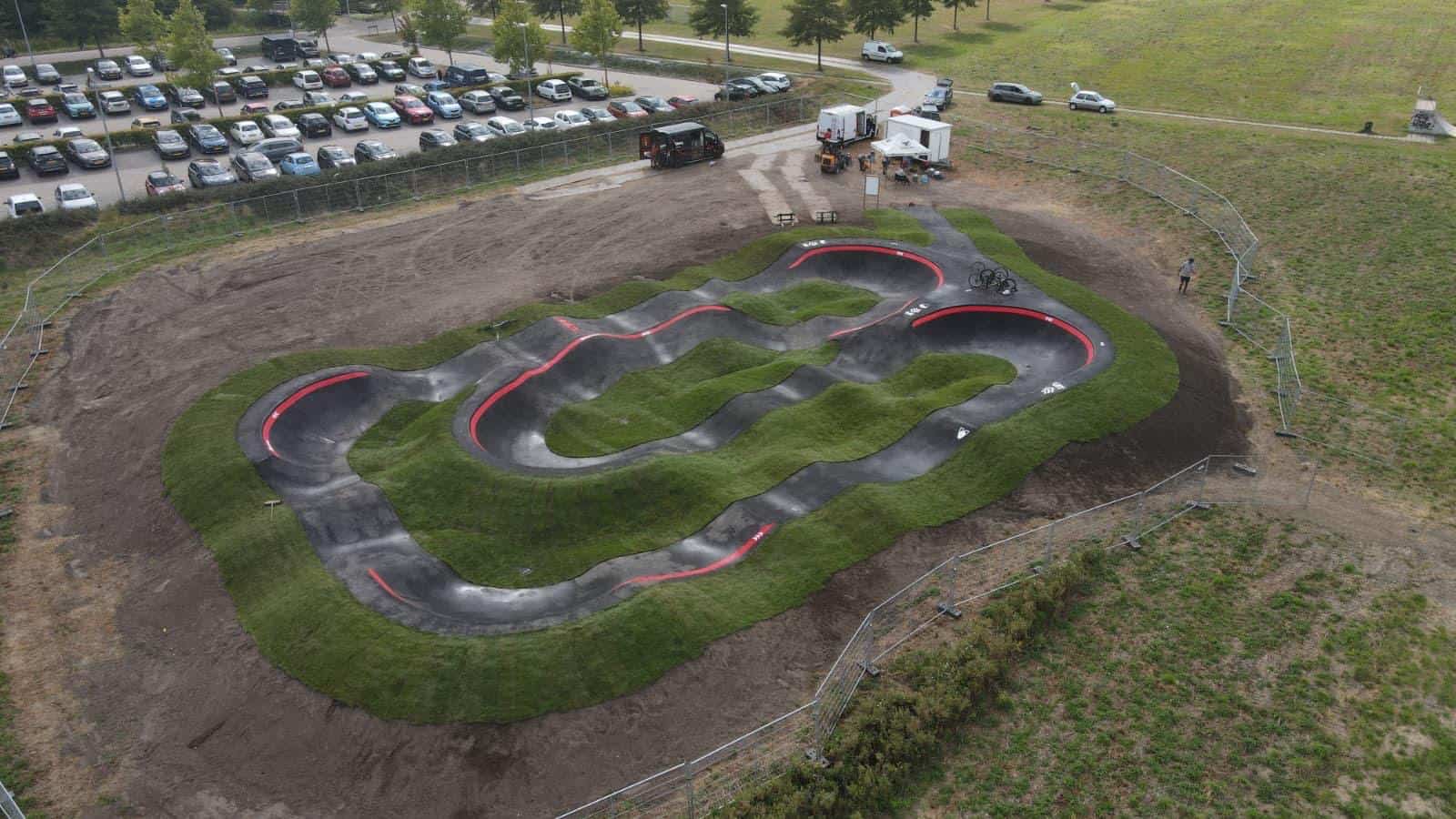
For a permanent asphalt PumpTrack, in most cases you need a environmental permit necessary, but that depends on the location, the zoning plan, and the size of the project. In addition, specific requirements apply from the WAS legislation (Amusement and Playground Equipment Act) for safety and certification. In this article, we answer the most frequently asked questions about the permit process, so you know what to expect before you start.
Do you always need an environmental permit for a PumpTrack?
Not always, but in most cases. Whether you need an environmental permit for a PumpTrack depends on the size of the structure, the location, and what the zoning plan allows. A small temporary setup sometimes falls under permit-free construction, but a permanent asphalt PumpTrack is almost always subject to a permit requirement.
The Environmental Law (General Provisions) Act (Wabo) determines when a structure requires a permit. An asphalt PumpTrack is considered a structure due to the permanent foundation and the asphalt construction. This means that in almost all cases, you must apply for an environmental permit for construction.
Exceptions are conceivable when it concerns a temporary or movable facility without a fixed foundation, but for a high-quality, durable PumpTrack that lasts at least 20 years, a permanent version is always the better choice. And therefore, the one requiring a permit.
What are the WAS requirements for a permanent PumpTrack?
De WAS legislation The Amusement and Playground Equipment Act stipulates that playground equipment and attractions accessible to the public must be safe and meet demonstrable standards. For a permanent PumpTrack, this means that the track must be designed and built in accordance with this. NEN-EN14974, the European standard for similar facilities. Skateparks are certified based on this standard, which applies specifically to this type of infrastructure.
In concrete terms, this means:
- The PumpTrack must be designed and built by a recognized party knowledgeable about the standard.
- After delivery, an inspection is carried out by an independent inspection body.
- You will receive a certificate demonstrating that the facility is safe and complies with legal requirements.
- Annual re-inspection is mandatory to maintain WAS status.
This may sound complicated, but it is actually an advantage. Municipalities that invest in a certified PumpTrack protect themselves against liability and can demonstrate that they manage public sports facilities responsibly. Moreover, the WAS requirements apply to all publicly accessible playground equipment in the Netherlands, so a PumpTrack is treated no differently than a swing or slide.
Do you want to know how a asphalt PumpTrack meets these standards? Then it is smart to work early in the process with a party that provides this certification as standard.
Want to have an asphalt PumpTrack installed?
500+ tracks worldwide · UCI certified · 5-year warranty
What role does the zoning plan play in the permit application?
The zoning plan determines what may be built and used at a location. If the desired location for a PumpTrack has a zoning designation such as sports, recreation, greenery or public space, there is a good chance that a PumpTrack fits within the applicable use. If this is not the case, an environmental permit for a deviation from the zoning plan is required, which makes the process longer and more complex.
It is therefore wise to check the land zoning designation when selecting a location. Municipalities can easily look this up via the omgevingsloket or ruimtelijkeplannen.nl. A location with a suitable zoning significantly speeds up the permit process.
Do you want to see what has already been achieved in other municipalities? View our completed projects for inspiration and practical examples.
How long does the permit process for a PumpTrack take?
A standard environmental permit for a PumpTrack takes on average 8 to 26 weeks, depending on the complexity of the application and the municipality. The statutory decision period for a regular procedure is 8 weeks, with a possible extension of 6 weeks. For an extensive procedure, for example if a deviation from the zoning plan is required, this can increase to 26 weeks or more.
In practice, there are a few factors that influence the lead time:
- Completeness of the application: An incomplete application leads to a delay.
- Objection from local residents: If objections are filed, the procedure may take longer.
- Capacity at the municipality: Some municipalities have longer processing times due to workload.
- Type of procedure: regular or extensive, depending on the zoning plan.
Therefore, plan the permit process well in advance. Those wishing to build in the spring are best advised to start preparations in the autumn.
Who is responsible for the permit application: the municipality or the contractor?
De The permit application is the responsibility of the client., in most cases the municipality itself. A contractor or construction party can submit the application on behalf of the client as an authorized representative, but the applicant remains legally responsible for the accuracy and completeness of the application.
In practice, the municipality often applies for the permit, while the contractor provides the technical drawings, calculations, and supporting documentation required for the application. Good cooperation between both parties accelerates the process.
For municipalities installing a PumpTrack for the first time, it is beneficial to work with a party that has gone through this process multiple times. Experience with the necessary documentation, WAS certification, and technical requirements saves a great deal of time and prevents errors in the application.
How much does it cost to apply for a permit for a PumpTrack?
The costs for an environmental permit for a PumpTrack vary by municipality, but are generally between a few hundred and a few thousand eurosMunicipalities calculate fees based on the construction cost or a fixed rate per type of application. The higher the investment in the PumpTrack, the higher the fees generally turn out to be.
In addition to the permit costs, there are additional costs to take into account:
- Inspection and certification by an independent inspector (mandatory for WAS certificate).
- Annual re-inspection to retain the WAS status.
- Potential costs for environmental advice if a deviation from the zoning plan is required.
Permitting and certification costs are a relatively small part of the total investment in a PumpTrack. Anyone calculating the total cost of ownership over several years will see that the low maintenance costs of asphalt and the long lifespan of at least 20 years amply justify the investment.
How Velosolutions helps with the permit process
Constructing a PumpTrack involves more than just soil and asphalt. The permitting process, WAS certification, and technical documentation require knowledge and experience. Velosolutions guides municipalities and recreation parks through the entire process, from initial sketch to a completed and certified track.
- We provide all technical documentation required for the environmental permit.
- Our PumpTracks are certified as standard according to WAS legislation and NEN-EN14974.
- We have more than 100 PumpTracks in the Netherlands realized and know the permit process inside out.
- We offer 5 year warranty and annual inspection and maintenance, so that the track continues to meet all requirements even after delivery. This maintenance can also be purchased via a maintenance contract.
- From design to inspection, we handle the complete package, so you can focus on what really matters.
Discover who we are and read more about our approach. Or request a no-obligation consultation and discover what is possible for your municipality or recreation park.