You determine the right design for a PumpTrack by clearly mapping out three things: the available space, the target audience you want to reach, and your budget. These three factors are closely interconnected and together form the basis of every good design. Below, you can read how to make these choices concrete and what you need to consider regarding design, safety, and legislation.
Which factors determine the size of a PumpTrack?
The size of a PumpTrack is determined by the available space, the expected number of users, and the desired level of the track. An entry-level model starts at approximately 400 to 600 square meters, while an extensive track for advanced riders quickly approaches 1.000 square meters or more. The available ground is often the most limiting factor in this regard.
Municipalities and recreation parks almost always work with limited space. The good news: a PumpTrack is compact relative to what it delivers. Where a traditional sports field offers one sport for one age group, a well-designed PumpTrack caters to everyone, from small to large, from beginner to advanced.
In addition to the surface area, the live a role. A PumpTrack preferably has a flat or slightly sloping surface, and good drainage is important to protect the lifespan of the asphalt. Also consider the surroundings: is there a sufficient line of sight for supervision, and is the location accessible for maintenance?
What shapes and layouts are possible for a PumpTrack?
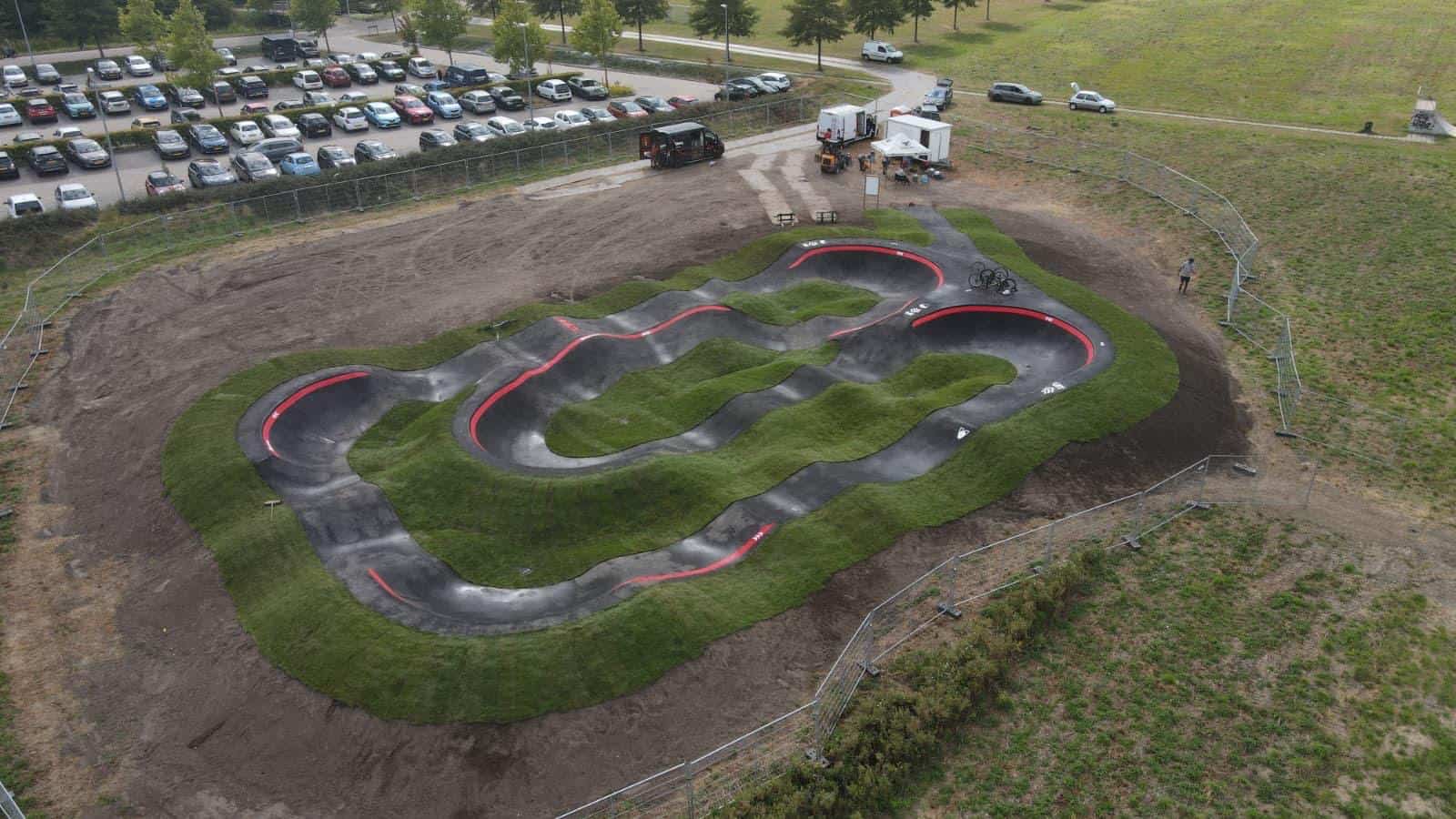
A PumpTrack can take on virtually any shape: oval, rectangular, D-shaped, or completely free-form. The layout always consists of a combination of rollers (small hills) and bends (verges), but how those elements are arranged is fully adaptable to the available space and the desired driving behavior.
For narrow or irregular fields, elongated or L-shaped layouts are easy to implement. At more spacious locations, you can opt for a loop with multiple branches, allowing riders of different skill levels to ride simultaneously without getting in each other's way. This also makes the track more suitable for busy times.
Do you want to know what is possible at your location? View our completed projects for a good overview of the variation in shapes, sizes, and environments.
Want to have an asphalt PumpTrack installed?
500+ tracks worldwide · UCI certified · 5-year warranty
How do you adapt a PumpTrack for different ages and skill levels?
A PumpTrack is adapted to ages and skill levels by varying the height of the rollers, the bank angle of the turns, and the riding line options. Lower, flowing rollers are accessible to small children on balance bikes, while higher and steeper elements offer a challenge for advanced BMX or mountain bike riders.
In practice, this means that a good design combines multiple levels within a single track. An inner loop with gradual slopes for beginners, and an outer loop with more challenging elements for advanced riders. This way, a six-year-old and a sixteen-year-old teenager can ride on the same track at the same time, each at their own level.
Create a asphalt PumpTrack Moreover, it is suitable for anyone with wheels: bicycles, skateboards, scooters, inline skates, and also wheelchairs — both manual wheelchairs and other variants. A handbike is not necessary for this. This makes it one of the broadest sports facilities you can build as a municipality or recreation park. No other facility reaches such a diverse group of users in such a small area.
What is the difference between an asphalt PumpTrack and other versions?
The main difference is durability and ease of maintenance. An asphalt PumpTrack lasts at least 20 years with minimal maintenance costs, whereas wooden or earthen versions wear out, subside, or rot much faster. Asphalt is weather-resistant, stable, and retains its ride quality the longest.
In addition to asphalt, there are also versions made of stabilized soil or modular plastic elements. These are sometimes cheaper to purchase, but entail higher maintenance costs and are often less suitable for intensive use in public spaces. For municipalities and recreation parks investing in a long-term facility, asphalt is the most cost-effective choice in the long run.
Another advantage of asphalt: it is laid by hand, meaning the contours of the track are formed precisely to size. This provides a driving quality that cannot be matched with prefabricated elements.
What requirements does WAS legislation impose on the design of a PumpTrack?
The Amusement and Playground Equipment Act (WAS) sets requirements for the safety of play facilities in public spaces. For PumpTracks, this means that the design must comply with the standard. NEN-EN14974, which applies specifically to facilities for wheelchair sports. After construction, the track must be inspected and certified before it may be put into use.
In practice, this means that during the design phase, you already take into account factors such as fall clearance around the track, the maximum banking angles of the curves, and the dimensions of the lanes. A design that fails inspection later costs time and money. It is therefore important to include this in the design phase.
PumpTracks that comply with WAS and NEN-EN14974 are supplied with an official certificate. This provides municipalities with the legal certainty they need in the management of public facilities.
How does the design process proceed from initial sketch to approval?
The design process for a PumpTrack runs from an initial site survey, through a sketch design and final design, to construction and eventual certification. This process takes several months on average, depending on the complexity of the location and the lead time of any permit procedures.
In practice, the steps look like this:
- Site survey: Assessment of the available space, soil conditions, and surroundings.
- Sketch design: A first proposal with shape, layout, and indicative dimensions.
- Final design: Detailed drawings including elevation profile, drainage, and driving lines.
- Permit and approval: Apply for any environmental permit and have the design reviewed.
- Build: Laying of the foundation and asphalt work by hand.
- Inspection and certification: Independent inspection and issuance of the NEN-EN14974 certificate.
Proper guidance throughout this process prevents surprises and ensures that the final result truly meets all requirements.
How Velosolutions helps with the design and construction of a PumpTrack
We guide municipalities and recreation parks through the entire process, from initial site scouting to inspection and certification. With over 100 completed PumpTracks in the Netherlands and 12 years of experience as a market leader, we know what works and what doesn't. We are part of the global Velosolutions network with 35 partners, and the only one in the world to be UCI-certified.
What we offer:
- Custom design based on your location, target audience, and budget
- Fully certified asphalt PumpTracks according to WAS and NEN-EN14974
- 5-year warranty and annual inspection and maintenance service, also available via a maintenance contract.
- Guidance for initiators and municipalities throughout the entire realization process
- Accessible for all ages and all wheel types, including manual wheelchairs
- Wearing a helmet is mandatory on Velosolutions PumpTracks.
Read more about who we are and what sets our approach apart. Or request a no-obligation consultation and discover what is possible at your location.