Financing a PumpTrack without your own budget is certainly possible, and municipalities do it more often than you might think. The most common routes are subsidies from sports funds and provinces, co-financing with local businesses, and citizen initiatives via crowdfunding. Which approach works best depends on the scale of the project, the local context, and how much time you have. In this article, we walk through all the options, from subsidy applications to lease arrangements.
Which grants and funds are available for a PumpTrack?
For a PumpTrack, multiple subsidy streams are available, depending on the province and the type of applicant. The most relevant are the Sports Agreement II (via municipalities and sports organizations), the Fund for Culture and Sports, provincial subsidy schemes for outdoor sports and movement-friendly environments, and funds from Jantje Beton or the Oranje Fonds for playgrounds. Many municipalities combine multiple sources to raise the required amount.
Specifically, these are the most accessible subsidy sources for a PumpTrack:
- NOC*NSF and the National Sports Week: incentive funds for urban sports and movement-friendly outdoor spaces
- Provincial subsidy schemesEach province has its own schemes for sports, green spaces, or livability. Search for “outdoor sports subsidy” or “movement-friendly public space” on your province’s website.
- Jantje Concrete: specifically for playgrounds for children and young people, including active outdoor play facilities
- Oranje Fonds: funds projects that promote social connection and interaction
- Municipal Fund and IZA funds: through the Integrated Care Agreement, resources are available for prevention and physical activity
An asphalt PumpTrack has a lifespan of at least 20 years and low maintenance costs. This makes it a strong case for subsidy applications where sustainability and long-term return are taken into account. Asphalt Pump Tracks score better in this regard than wooden or modular alternatives, which wear out faster and have higher replacement costs.
Can a PumpTrack be financed through citizen participation or crowdfunding?
Yes, crowdfunding and citizen participation are proven ways to (co-)finance a PumpTrack. Platforms such as Fordekunst, 1% Club of Crowdfundingplatform.nl are suitable for sports projects with a social component. Citizen participation also serves as proof of support, which strengthens grant applications.
A crowdfunding campaign does two things at once: it raises money and shows the municipality that there is a real need for a PumpTrack in the neighborhood. The latter is sometimes even more valuable than the former. Municipalities that doubt whether there are enough users are convinced by a neighborhood that actively participates itself.
Practical tips for a successful crowdfunding campaign:
- Set a realistic target amount, preferably as a supplement to a larger financing mix.
- Make the campaign personal: who are the initiators, and which children and young people in the neighborhood benefit from it?
- Offer rewards that make sense, such as a name on a sign or an opening with the neighborhood.
- Actively use social media during the campaign
Do you want to build a PumpTrack yourself as a resident? We help initiators with a step-by-step plan and a petition tool to mobilize supporters and convince the municipality. That way, you don't have to do it alone.
Want to have an asphalt PumpTrack installed?
500+ tracks worldwide · UCI certified · 5-year warranty
How does co-financing with private parties or sponsors work?
Co-financing with companies works because a local or regional sponsor makes a contribution in exchange for visibility, brand awareness, or social involvement. Think of a sports store, construction company, insurer, or supermarket chain active in the municipality. In exchange for a contribution, they receive name recognition on the premises or in communications surrounding the opening.
Companies eligible for co-financing of a PumpTrack:
- Local entrepreneurs who want visibility in the neighborhood
- Sports brands and bicycle dealers who benefit from an active user group
- Housing associations who invest in livability in their neighborhoods
- Insurers and health insurers financially support prevention and physical activity
- Regional construction companies who use their CSR budget for visible projects
A PumpTrack is an attractive object for sponsors: it is visible, popular with a broad target audience, and has a long lifespan. This makes it easier to start a conversation than at a bench or trash can. View our completed projects for examples of how other municipalities have tackled this.
What are the total costs and what is the financial return of a PumpTrack?
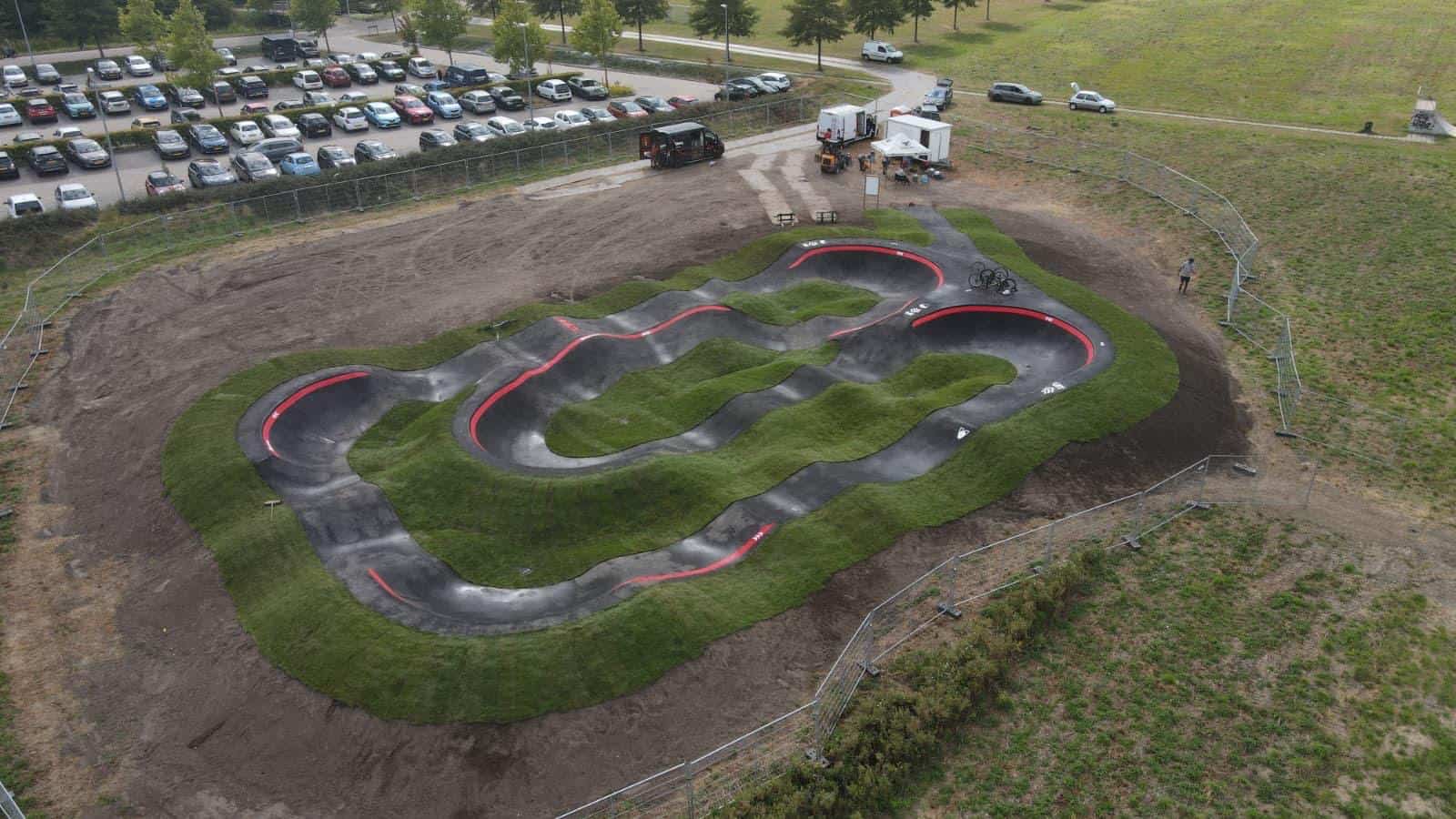
An asphalt PumpTrack costs on average between €80.000 and €250.000, depending on the size and design. In return, it offers a lifespan of at least 20 years, low annual maintenance costs, and a wide appeal across all age groups. Consequently, the cost per user per year is lower than at most traditional playgrounds or skateparks.
Below is a general overview of the cost breakdown and what you get in return:
- Installation costs: depending on size, design and site preparation
- Annual maintenance: relatively low due to the durability of asphalt; Velosolutions offers annual inspection and maintenance, also via a maintenance contract
- Longevity: minimum 20 years, including 5-year warranty
- Target audience: from toddlers on balance bikes to adults on BMX bikes, also suitable for skateboards, scooters, and inline skates; the gradual curves and accessible layout also make the track suitable for users of manual wheelchairs.
- Safety: wearing a helmet is mandatory on Velosolutions PumpTracks; the track complies with the NEN-EN 14974 standard for skate facilities
In addition to direct costs, a PumpTrack also generates indirect returns: increased physical activity among residents, a more attractive public space, and a facility that draws people from outside the neighborhood or municipality. For recreation parks, moreover, a PumpTrack retains guests longer and distinguishes them from competing parks.
How do you write a successful grant application for a PumpTrack?
A successful grant application for a PumpTrack rests on three pillars: demonstrable support, a clearly defined target group, and a financially sound plan. Grant providers want to know who uses it, how long the facility will last, and whether the municipality or the initiator also contributes. The more concrete you are, the greater the chance of success.
Follow this step-by-step plan for a strong application:
- Describe the problem: What is the need for space to move around in the neighborhood or municipality? Use local figures on inactivity or the lack of sports facilities for young people.
- Define the target groupA PumpTrack reaches children, young people, and adults. That broad reach is a strong argument.
- Justify the choice for asphalt: demonstrable sustainability, low maintenance costs, and certification make it a responsible investment
- Show support: signatures, a crowdfunding campaign, or a letter from a local sports club strengthen the application
- Present a financing mixGrant providers prefer that you do not ask them for everything. Combine multiple sources.
- Add referencesMunicipalities that have already implemented a PumpTrack are convincing proof that it works.
Also ensure that you explicitly mention the certification and safety. Grant providers and municipal councils want assurance that the facility complies with the NEN-EN 14974 standard for skateboarding facilities. This is not a minor detail, but a condition that immediately strengthens your application.
When is a phased construction or lease arrangement an option?
Phased construction or a lease arrangement is a good option if the total budget is not available right now, but the need is clear. With phased construction, you start with a smaller track that is expanded later. With a lease arrangement, you agree on the costs over several years, which reduces the pressure on the annual budget.
Phased construction works well if:
- The available space is larger than the current budget allows.
- You want to build support before making a larger investment
- Subsidies are awarded in tranches.
A lease arrangement is attractive if:
- The municipality prefers to put investment costs rather than operating costs in the budget
- There is an annual budget available for sports and public space, but no one-off investment budget.
- You want to start quickly without waiting for a grant round
Always carefully inquire about the total costs over the term of a lease arrangement, and compare that to the upfront purchase costs plus maintenance. Sometimes a one-time investment is more advantageous in the long run, even if it feels more burdensome now.
How Velosolutions helps finance a PumpTrack
We understand that financing is often the biggest hurdle for municipalities wishing to realize a PumpTrack. Therefore, we guide not only the design and construction, but also the process leading up to it. In concrete terms, this means:
- Advice on the most promising subsidy streams for your situation
- Support in putting together a financing mix
- Assistance to initiators with a petition tool and step-by-step plan to create support
- Reference projects of more than 100 realized PumpTracks in the Netherlands
- A fully certified product according to the NEN-EN 14974 standard for skate facilities, which strengthens subsidy applications.
- 5-year warranty and annual inspection and maintenance service — also available via a maintenance contract — so that the investment pays off for years.
With 12 years of experience as a market leader in the Netherlands and more than 35 partners worldwide, we know exactly what works and what doesn't. Read more about us of request a no-obligation consultation and discover what is possible in your municipality.