A PumpTrack provides a neighborhood with an accessible, sustainable sports facility that gets people of all ages moving. Unlike a playground or skatepark, a PumpTrack attracts a broad target audience: from toddlers on balance bikes to teenagers on BMX bikes and adults who just want to get some exercise. In this article, we answer the most frequently asked questions about PumpTracks, from target audience and costs to safety and lifespan.
For what ages is a PumpTrack suitable?
A PumpTrack is suitable for all ages, from about 2 years old well into adulthood. The track works for anyone with wheels: balance bikes, children's bikes, skateboards, scooters, inline skates, or BMX bikes. This makes it one of the widest sports facilities a municipality can build on a relatively small plot of land.
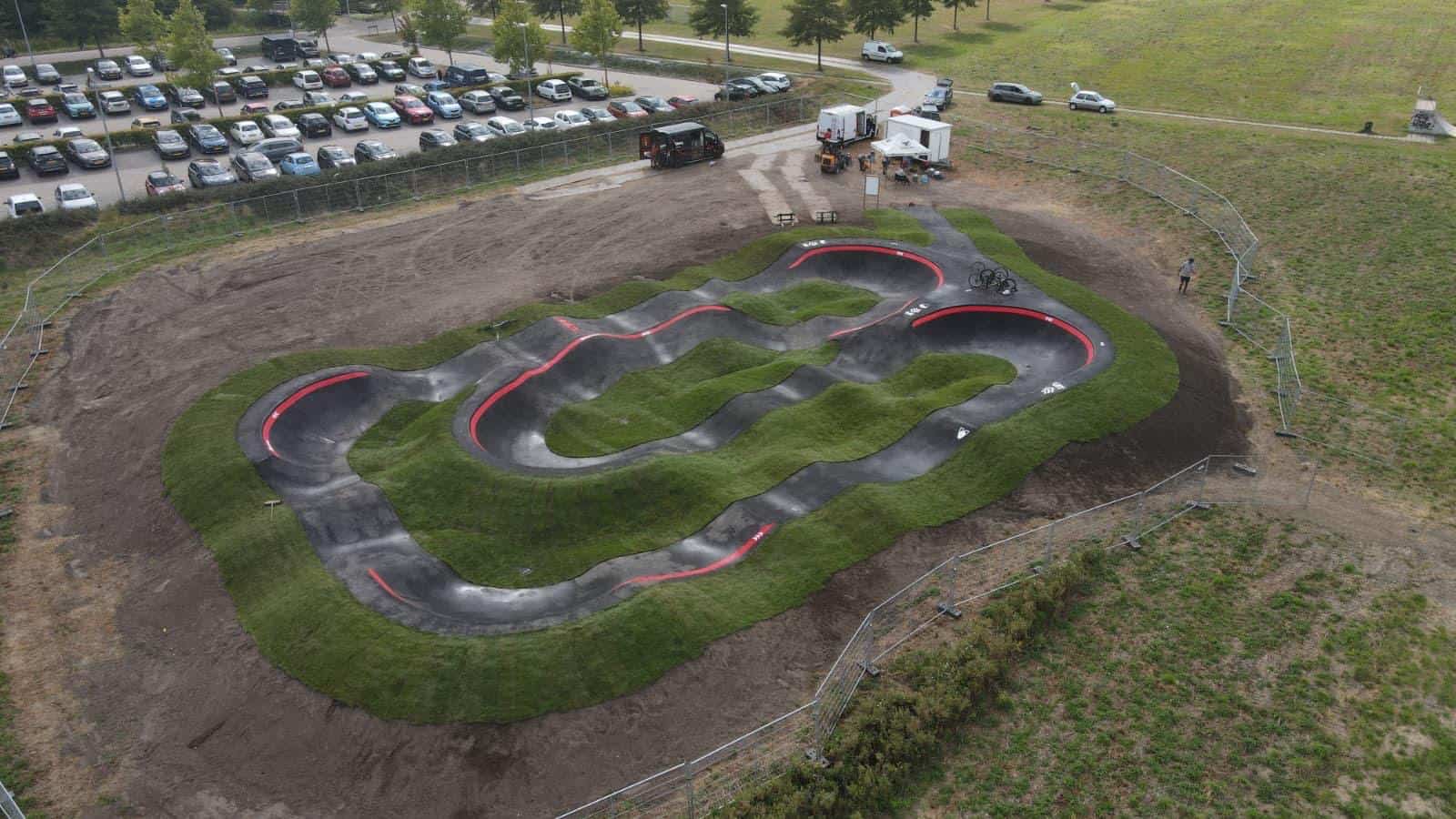
The key lies in the design. A well-designed asphalt PumpTrack It consists of rollers and gradual turns that you “pump” with your body weight instead of pedaling. Small children ride the track calmly at their own pace, while advanced riders use the same track to build speed and practice tricks. No level separation is necessary: the track adapts to the rider.
That is exactly why municipalities and recreation parks are so enthusiastic about the concept. One facility caters to the toddler, the teenager, and the accompanying parent. That is something a traditional playground or skatepark simply does not offer.
How does a PumpTrack encourage physical activity in the neighborhood?
A PumpTrack encourages exercise because the track is challenging enough to keep coming back, yet accessible enough to start immediately. You don't need to learn anything or sign up. You grab your bike, ride to the track, and just go. That combination of accessibility and progression ensures regular use.
Research into outdoor sports and play behavior consistently shows that children and young people are more active when the play area is challenging and social. A PumpTrack offers both. Riders watch each other, learn from each other, and challenge each other. That social aspect draws people back, even if they can already ride well.
For municipalities looking to tackle inactivity, that is a strong argument. The track is available 24/7, requires no supervision, and has no opening hours. Residents can go there at any time, even after school or work.
Want to have an asphalt PumpTrack installed?
500+ tracks worldwide · UCI certified · 5-year warranty
What is the difference between a PumpTrack and a skatepark?
The biggest difference is the target audience. A skatepark is primarily designed for skaters and advanced riders, whereas a PumpTrack is accessible to anyone with wheels, regardless of age or skill level. A PumpTrack has no sharp edges, no steep drops, and no elements intended only for advanced riders.
Here is a handy overview of the key differences:
| Characteristic | PumpTrack | Skatepark |
|---|---|---|
| Target audience | All ages, all levels | Mainly teenagers and advanced players |
| Accessibility | Accessible, no prior knowledge required | Higher entry threshold |
| Means of transportation | Bicycle, scooter, skateboard, inline skates | Primarily skateboard and BMX |
| Maintenance | Low for asphalt version | Varying, depending on the material |
| Longevity | At least 20 years old | Changing |
A skatepark certainly has its value, but it serves a narrower group. If a municipality chooses between the two and the goal is to get as many people as possible moving, a PumpTrack scores better on almost all points. Do you want to know what has already been realized in your municipality or region? View our completed projects for concrete examples.
How much does a PumpTrack cost a municipality?
The costs for a PumpTrack depend on the size, design, and location, but generally, expect an investment between €80.000 and €200.000 for a standard municipal asphalt PumpTrack. Larger or more complex designs are more expensive. That sounds like a lot, but the cost per user over the lifespan of the track is remarkably low.
A useful way to assess the investment is to calculate the total cost of ownership. A PumpTrack lasts at least 20 years, has low maintenance costs, and attracts dozens to hundreds of users daily. Compared to other sports infrastructure, such as an artificial turf field or an indoor sports hall, the cost per user of a PumpTrack is strong.
Municipalities can also apply for subsidies for outdoor sports and physical activity infrastructure. National funds such as the National Sports Agreement and provincial subsidy schemes still offer opportunities for these types of investments in 2026. It pays to look into this early in the process.
How long does an asphalt PumpTrack last?
An asphalt PumpTrack lasts at least 20 years with normal use and regular maintenance. As a material, asphalt is much more durable than wood or concrete for this type of application. It weathers less quickly, is resistant to rain and frost, and requires fewer repairs than wooden structures.
Annual maintenance plays a major role in the lifespan. Small cracks or wear can be addressed early before they worsen. This is much cheaper than waiting until major repairs are necessary. Velosolutions offers annual inspection and maintenance, also via a maintenance contract, to ensure the track remains in good structural condition. A well-maintained PumpTrack also remains safer, which is important for certification.
Asphalt has another practical advantage: the surface dries quickly after rain, making the track usable for most of the year. This increases usage and, consequently, the societal value of the investment.
What safety requirements apply to a PumpTrack in the Netherlands?
In the Netherlands, PumpTracks installed in public spaces must comply with the Amusement and Playground Equipment Act (WAS) and the associated standard NEN-EN14974. These are the same legal requirements that apply to recognized playground equipment. A municipality is obliged to work with certified facilities that meet these standards.
The NEN-EN14974 standard sets requirements for the construction, material selection, dimensions, and safety margins around the track. After completion, the track must be inspected by a recognized inspector, who issues a certificate. Without that certificate, the track may not be officially put into use.
For municipalities, this is an important point when choosing a supplier. Not every builder provides a track that meets all requirements or guides the certification process. Always ask for proof of certification and check whether the supplier has experience with Dutch regulations.
Is a PumpTrack also suitable for people with a disability?
A PumpTrack by Velosolutions is also suitable for wheelchair users, including manual wheelchairs. A handbike is not necessary for this. The asphalt surface and the smooth, gradual curves make it possible to explore the track with a manual wheelchair as well. This makes the PumpTrack an inclusive sports facility that gets an even broader group of people moving.
How Velosolutions helps with installing PumpTrack
At Velosolutions, we are the market leader in the Netherlands with 12 years of experience and over 100 completed PumpTracks. We guide municipalities and recreation parks from the initial consultation through to delivery and the annual inspection. Our tracks comply with WAS legislation as standard and are supplied with a certificate in accordance with NEN-EN14974. Therefore, you do not have to search for an inspector yourself or puzzle over the regulations.
Wearing a helmet is mandatory on all Velosolutions PumpTracks. This contributes to a safe environment for all users.
What we offer:
- Custom design that fits the location, the budget, and the target audience
- Specialized manual processing of the asphalt for a perfect driving surface
- 5 year warranty on all PumpTracks
- Annual inspection and maintenance, also available via a maintenance contract, so that the track remains in top condition
- Full certification according to WAS and NEN-EN14974
- Guidance for initiators who want to convince their municipality
Read more about us and discover how we have been working on movement-friendly neighborhoods in the Netherlands and beyond for more than a decade. Ready to explore the possibilities for your municipality or park? Request a no-obligation consultation and we are happy to think along with you.