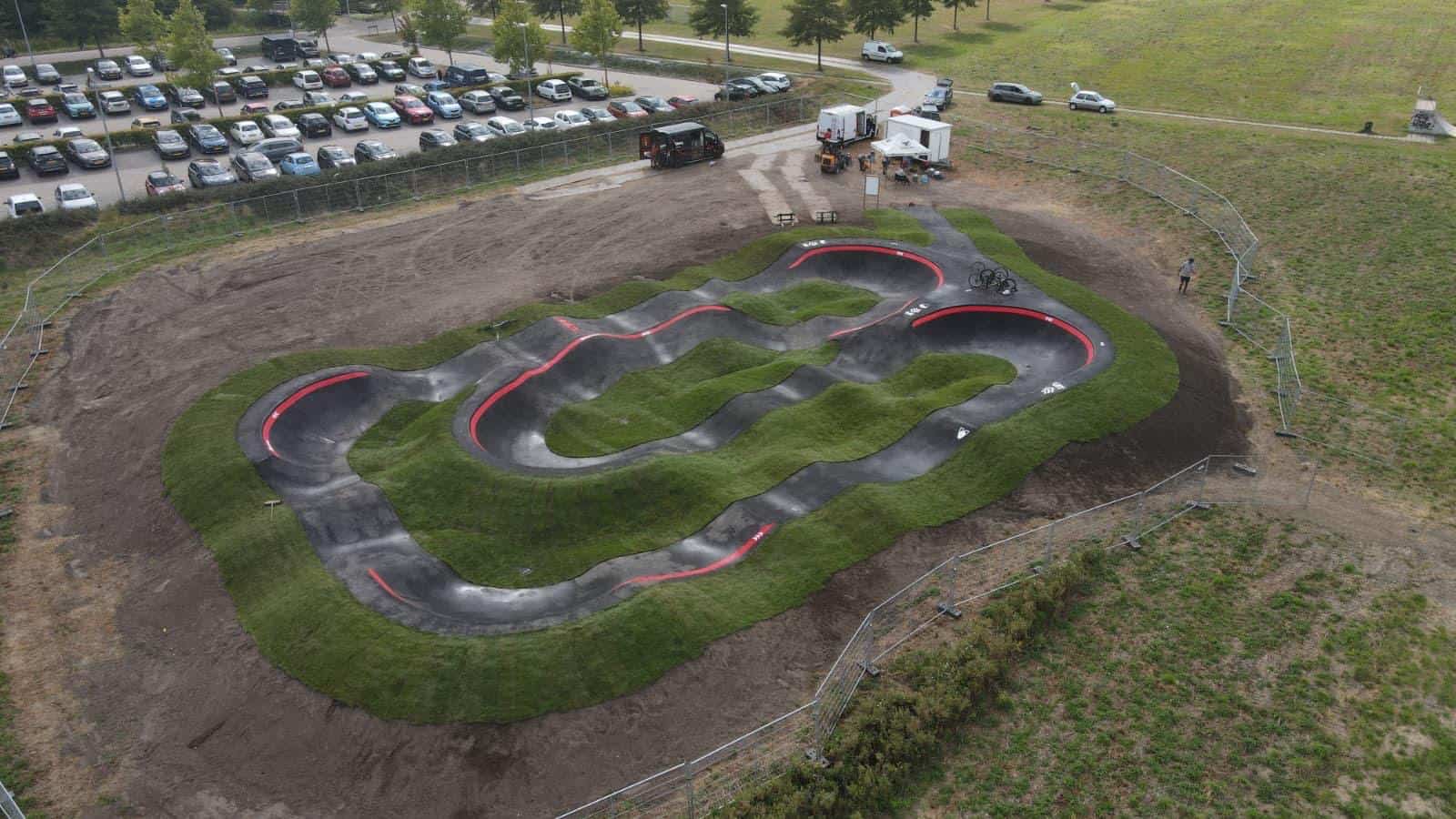
You apply for a PumpTrack from your municipality by contacting the Sports, Public Space, or Neighborhood Management department and submitting a concrete proposal. How you go about this depends on who makes the decisions within the municipality and how far the idea has already been developed. In this article, we answer the most frequently asked questions about the process, from initial contact to official realization.
Who decides on a PumpTrack within a municipality?
Within a municipality, the Policy Officer for Sport and Public Space typically decides on new sports facilities, such as a PumpTrack. In larger municipalities, there is sometimes a separate team for Play Areas or the Living Environment. Final approval rests with the Alderman for Sport or the Municipal Council, depending on the budget and political priorities.
It is smart to start with the neighborhood manager or the public space reporting point. They know who the right person is internally to talk to. Explicitly ask for the Sports Policy Officer or the contact person for play facilities. This way, you reach the decision-maker faster and prevent your request from disappearing into a mailbox somewhere.
In many municipalities, residents' platforms or neighborhood councils also play a role. If they support your initiative, it gives weight to your request. The more people who support the idea, the more seriously the municipality takes it.
How do you submit a request for a PumpTrack to your municipality?
You submit a request for a PumpTrack by sending a written proposal to the appropriate department, preferably including substantiation of the need, a proposed location, and support from the neighborhood. A concrete proposal with signatures or a petition makes the difference between an idea that is quickly dismissed and one that is seriously discussed.
Follow these steps for a strong request:
- Find the right contact person via the municipal website or the general telephone number.
- Collect signatures or expressions of support from local residents, schools, or sports clubs.
- Choose a specific location and explain why it is suitable (surface area, accessibility, target group).
- Write a brief substantiation with information about what a PumpTrack is, who uses it, and what it costs.
- Request a conversation instead of just sending an email, so you can answer questions directly.
A well-developed proposal shows that you are serious and makes it easier for the municipality to say yes. The more concrete, the better.
Want to have an asphalt PumpTrack installed?
500+ tracks worldwide · UCI certified · 5-year warranty
What arguments convince a municipality to install a PumpTrack?
Municipalities are most convinced by arguments regarding a broad target audience reach, low maintenance costs, and demonstrable safety. A PumpTrack scores highly on all these points compared to traditional playground equipment or a skatepark, which typically serve only a limited age group.
The strongest arguments are:
- Wide range: a asphalt PumpTrack It is suitable for anyone with wheels, from toddlers on balance bikes to adults on BMX bikes, skateboards, scooters, or inline skates. That makes it one of the widest range of sports facilities a municipality can build.
- Long lifespanAsphalt lasts at least 20 years and is more sustainable than wood or concrete, which keeps the investment per user low.
- Encouraging exerciseA PumpTrack draws people outdoors and encourages physical activity in an accessible way, which aligns with municipal sports policy.
- Space efficiency: you can serve many users on a relatively small surface.
- References: more than 100 PumpTracks have already been realized in the Netherlands. View our completed projects to show municipalities what is possible.
Concrete examples from other municipalities work best. Show what a comparable municipality has done and what the results have been.
Is there a subsidy available for a PumpTrack?
Yes, there are various subsidy options for a PumpTrack, from the national government as well as from provinces and funds. Availability varies by region and year, but in 2026, several relevant schemes are active that municipalities can make use of.
Think of:
- SPUK schemeThe Specific Grant for Sports Infrastructure from the central government supports municipalities in investing in sports accommodations and outdoor sports facilities.
- Provincial subsidy schemesMany provinces have funds for physical activity-friendly outdoor spaces or youth sports.
- Fund for local sports: contributions for innovative sports facilities are sometimes available via NOC*NSF or the National Sports Agreement.
- District budgetsSome municipalities have their own budgets for livability or play areas that can be used.
It is wise to ask, when submitting a request, which subsidies the municipality itself offers or applies for. Municipalities often have more financial leeway than you might think if the correct scheme is known.
How long does it take for a municipality to construct a PumpTrack?
From the initial request to the opening of a PumpTrack, it takes an average of one to two years. Most of the time is spent on decision-making and going through municipal procedures, not on the construction itself. The construction of an asphalt PumpTrack typically takes only a few weeks.
A global timeline looks like this:
- Request and initial discussions: 1 to 3 months
- Decision-making and budget approval: 3 to 6 months
- Design and permit process: 3 to 6 months
- Talent: 2 to 4 weeks
- Inspection and certification: 1 to 2 weeks
The process accelerates if you start building support early and a location has already been designated in the municipal playground policy. The better your proposal is prepared, the less delay occurs in the decision-making phase.
What are the legal requirements that a municipality must meet for a PumpTrack?
A municipality is required to ensure that a PumpTrack complies with the Dutch Amusement and Playground Equipment Act (WAS) and the European standard NEN-EN14974. These are the same legal requirements that apply to approved playground equipment. A PumpTrack must be inspected and certified before it is put into use.
In concrete terms this means:
- The track must be designed and built in accordance with the technical requirements of NEN-EN14974.
- After the construction, a official inspection by a certified inspector.
- The municipality receives a certificate that demonstrates that the facility is in safe and legal use.
- Annual inspections are necessary to continue guaranteeing safety and to remain compliant with the WAS Act.
For municipalities, this is an important point: if the supplier does not arrange the certification, that responsibility lies with the municipality itself. It is therefore wise to choose a party that handles the entire process from design to inspection.
How Velosolutions helps with applying for a PumpTrack
Velosolutions assists not only municipalities with the construction of a PumpTrack, but also initiators who want to convince their municipality. We offer a concrete step-by-step plan, support in building public support, and all the information you need to submit a strong proposal. As the market leader in the Netherlands with over 100 realized PumpTracks and 12 years of experience, we know exactly what municipalities need to make a decision.
What we offer:
- Guidance from the initial idea to the official inspection and certification
- Custom design, suitable for all ages and all wheels
- Full certification according to WAS legislation and NEN-EN14974
- 5-year warranty, annual inspection and maintenance — also available via a maintenance contract
- Reference projects from other municipalities and recreation parks
- Support for initiators, including petition tool and list of arguments
Read more about us and discover why municipalities throughout the Netherlands choose Velosolutions. Do you want to get started right away? Request a no-obligation consultation and we help you on your way.