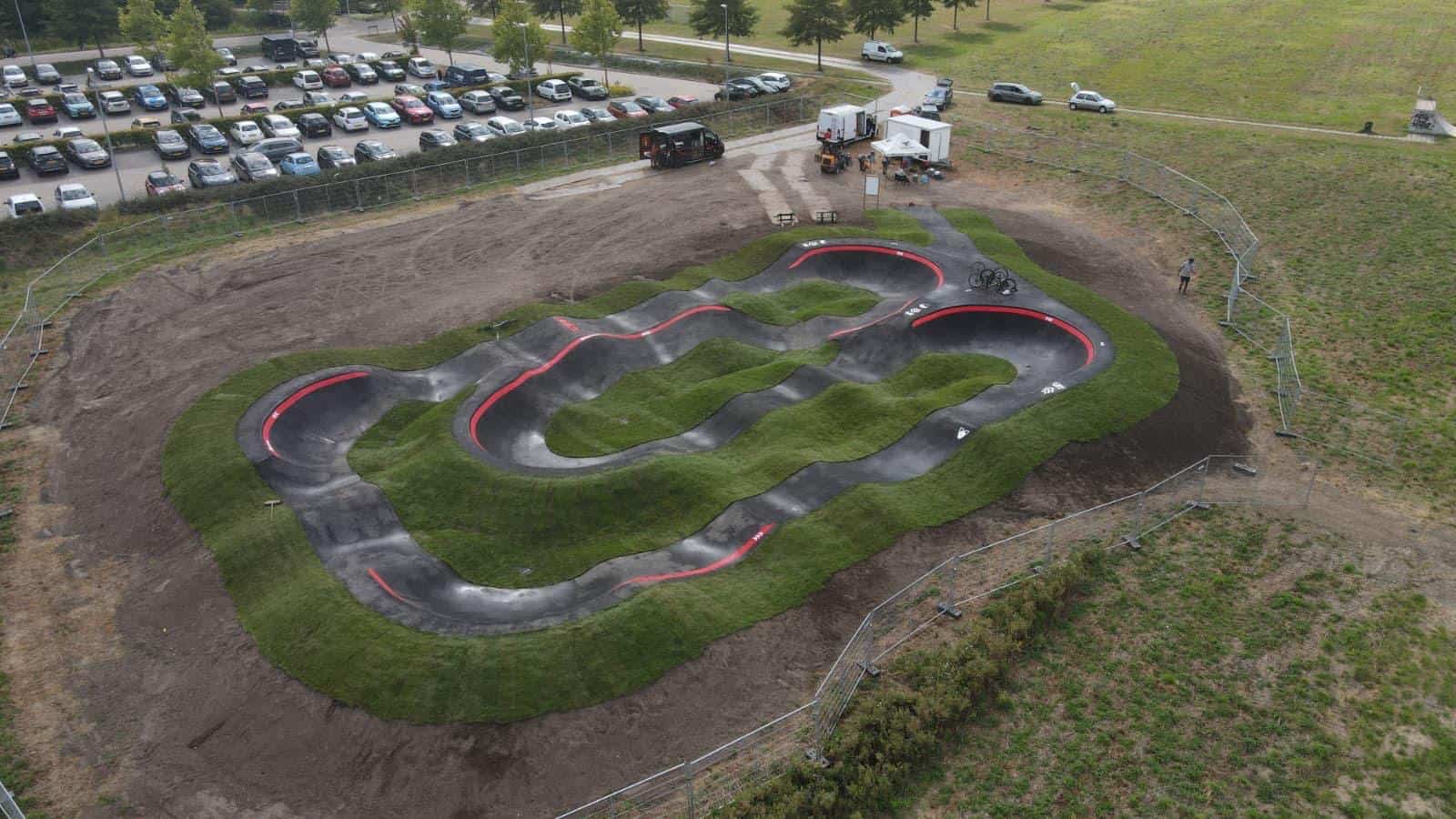
The three most important design choices when building a PumpTrack are: the size and shape of the track. Then type of subsurface (asphalt or modular) and the difficultyThese three choices determine who the track is accessible to, how long it will last, and what the total investment will be. Below, we answer the most frequently asked questions about building a PumpTrack so that you know exactly what to look out for.
What influence does the size of a PumpTrack have on usage?
The size of a PumpTrack directly determines how many people can use it at the same time and for which age groups the track is suitable. A small track of about 200 to 400 square meters is fine for younger children and beginners. If you also want to cater to teenagers and adults, you will quickly need 500 to 800 square meters for a comfortable riding experience.
A larger track offers more variety in the route, which increases repeatability. Users ride longer if there is plenty to discover. That is not only more fun, but it is also the reason why larger tracks attract more returning visitors. This is relevant for municipalities: a PumpTrack that is used intensively justifies the investment more easily.
At the same time, a huge job is not always better. The available space, the budget, and the target group together determine the ideal size. A well-designed 400-square-meter court that fits perfectly into the neighborhood performs better than an oversized court that stands half empty. So, don't just look at square meters, but at the relationship between space, usage, and target audience.
Which shape do you choose for a PumpTrack: oval, loop, or freeform?
The shape of a PumpTrack determines the riding experience and how well the track fits the available location. An oval or round track is the most classic: clear layout, suitable for beginners, and easy to monitor. A loop shape with branches offers more challenge and variety. A free-form design adapts to the location and gives designers the most freedom.
For municipalities with a rectangular plot of land, an oval track is often the most efficient choice. The shape aligns with the available space and leaves few wasted corners. Free forms are interesting on irregular terrain, such as a park with trees or a location with elevation differences. These elevation differences can then be cleverly utilized as part of the design.
A loop with multiple routes is popular with mixed target groups because you can design an easier and a more difficult line side by side. Beginners and advanced riders then ride on the same course without getting in each other's way. This makes the course more attractive to a wider audience, which is a significant advantage for municipalities and recreation parks.
Want to have an asphalt PumpTrack installed?
500+ tracks worldwide · UCI certified · 5-year warranty
What is the difference between asphalt and modular PumpTracks?
The main difference between asphalt and modular PumpTracks lies in durability, riding experience, and total cost over the lifespan. An asphalt PumpTrack is a permanent structure that is laid and finished by hand. A modular track consists of separate plastic elements that you can move or expand.
With proper maintenance, an asphalt PumpTrack has a lifespan of at least 20 years and offers a smooth, fast riding experience suitable for all types of wheels: bicycles, skateboards, scooters, and inline skates. Maintenance costs are low and the track is usable all year round. Modular tracks are cheaper to purchase, but wear out faster and offer less riding comfort, especially in wet or cold weather.
For a permanent location, such as a neighborhood, park, or recreation park, asphalt is almost always the better choice in the long run. The higher initial investment pays for itself through the long lifespan and low maintenance costs. Would you like to know more about what a permanent asphalt PumpTrack What does that entail? We explain everything about it.
How do you determine the difficulty level of a PumpTrack?
The difficulty of a PumpTrack depends on the height and steepness of the rollers and turns, the length of the track, and the combination of elements. Higher rollers and steeper turns require more technique and strength. Lower, flowing elements are more accessible to younger children and beginners.
A good PumpTrack combines both. By incorporating an easy line and a more challenging line into the same design, you cater to multiple skill levels simultaneously. A toddler on a balance bike can take the outer, flat line, while a teenager on a BMX takes the steeper inner line. That is exactly what distinguishes a PumpTrack from a skatepark or playground: one job that appeals to everyone, from toddler to adult, on any type of wheeled vehicle.
When determining the difficulty level, also consider the primary target audience of the location. Is the track intended for a residential area with many young children? Then choose lower elements with gradual transitions. Is it a sports park aimed at active youth and adults? Then the track may be more challenging, with higher rollers and faster turns.
What safety requirements apply to a PumpTrack in the Netherlands?
In the Netherlands, a PumpTrack must comply with the Amusement and Playground Equipment Act (WAS) and the associated standard NEN-EN14974. This legislation applies to all playground equipment accessible to the public, including pumptracks. Wearing a helmet is mandatory on Velosolutions PumpTracks. A track that meets the WAS requirements is supplied with a certificate and may be officially put into use.
The WAS legislation stipulates, among other things, that the course must be inspected periodically and that a risk analysis must be carried out. As a municipality or recreation park, you, as the manager, are responsible for the safety of the facility. This also means that you must maintain a record of inspections and any repairs.
If you choose a professional installer, they will take care of full certification and deliver the track with all the necessary documentation. This relieves a significant concern, especially for municipalities dealing with strict tendering requirements and accountability towards residents. View our completed projects to see how this works in practice.
Who should you involve in the design of a PumpTrack?
Ideally, when designing a PumpTrack, you involve the future users, the site manager, the municipality, and a specialized designer. Each of these parties contributes something valuable: users know what they want to ride, managers know the location, and the municipality sets the framework for safety and permits.
Involving future users, such as children, young people, and local residents, creates greater support and ensures a track that is actually used. Participation processes do not have to be complicated: a short survey, an open evening, or an online poll are sufficient to map out the wishes.
The designer translates all that input into a technical design that fits within the available budget, space, and applicable safety standards. The earlier you involve the designer, the better: at that point, you can still influence the layout of the space, the choice between asphalt or modular surfaces, and the difficulty level of the course.
How Velosolutions helps build your PumpTrack
Velosolutions is the market leader in the Netherlands with over 12 years of experience and more than 100 installed PumpTracks. We guide municipalities and recreation parks from the initial consultation to completion and annual inspection. This means that as a client, you are completely unburdened, from design and the permitting process to certification and maintenance.
- Custom-designed asphalt PumpTracks, suitable for all ages and all wheels — manual wheelchairs are also welcome on the track
- Fully certified in accordance with WAS legislation and NEN-EN14974, including certificate upon completion
- 5 year warranty and a lifespan of at least 20 years
- Annual inspection and maintenance so that the track always remains in top condition, to be purchased via a maintenance contract.
- Guidance for initiators who want to convince their municipality
- Part of a global network of 35 partners with proven expertise
Read more about us and discover how we have already helped more than a hundred municipalities and recreation parks. Do you want to know what is possible for you? Request a no-obligation consultation and we are happy to think along with you.