Teenagers are the forgotten target group of playgrounds: too old for the slide, too young for the gym. The result? They hang out on the streets or sit at home behind a screen. But it doesn't have to be that way. There are outdoor play facilities that truly appeal to teenagers, that challenge them, and that bring them back time and time again. In this article, you will read which facilities work best for teenagers and how municipalities can respond smartly to this.
Why are there so few play facilities for teenagers?
Most playgrounds are designed for children up to about ten years old. Teenagers are systematically left out, because traditional playground concepts are not tailored to their need for challenge, freedom, and social interaction. The result is a large gap in the provision of play facilities in many municipalities.
Teenagers don't want a swing or a seesaw. They seek physical activity with a touch of risk, space to practice and improve, and a place where they can hang out with friends. Traditional playground equipment does not offer that. Skateparks and sports fields come closer, but even they fail to reach nearly all teenagers. Moreover, many facilities are geared towards a single sport, which limits the target audience.
Municipalities are struggling with this problem. Scarce land, limited budgets, and the pressure to reach as many residents as possible make it difficult to make the right choice. Nevertheless, the demand for suitable places for teenagers is greater than ever, especially now that inactivity among young people is increasing.
What are the most popular outdoor play facilities for teenagers?
The most popular outdoor play facilities for teenagers are skate parks, PumpTracks, calisthenics parks, street basketball courts, and urban sports spots. These facilities have in common that they offer a challenge, are freely accessible, and require no supervision. Teenagers can go there at their own pace and decide for themselves how to exercise.
Of these options, PumpTracks and skateparks are the most versatile. They attract not only teenagers but also younger children and adults. Calisthenics parks and basketball courts focus more on a specific sport, which narrows the target audience. For municipalities that want maximum reach with minimal space, PumpTracks and urban sports facilities are the most logical choice.
Want to have an asphalt PumpTrack installed?
500+ tracks worldwide · UCI certified · 5-year warranty
What is a PumpTrack and why is it suitable for teenagers?
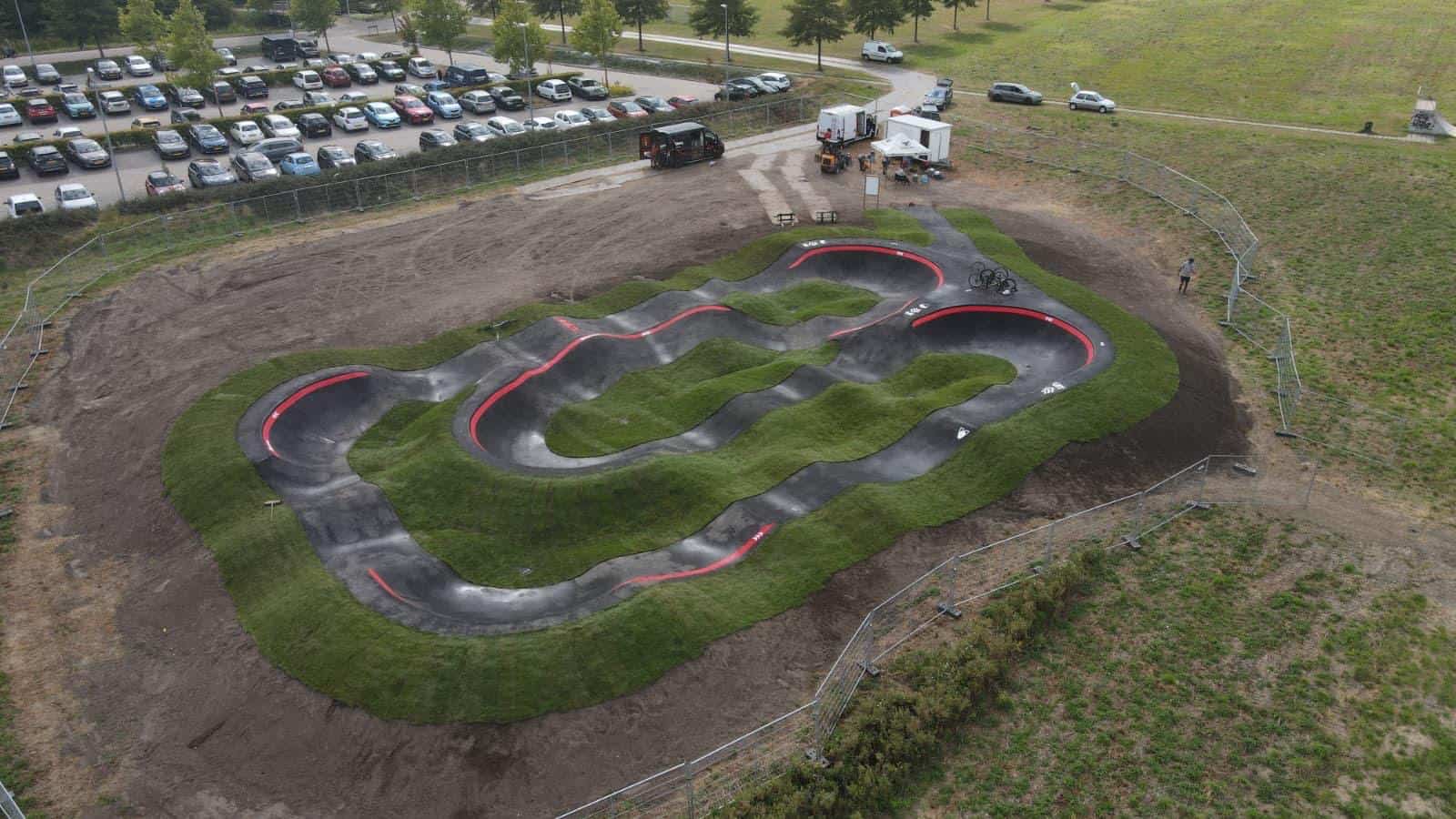
A PumpTrack is a continuous circuit of hills and curves that you can ride without pedaling, using your body weight. You “pump” yourself forward with your arms and legs. The track is suitable for bicycles, skateboards, scooters, and inline skates, thereby attracting a wide range of users, including teenagers.
For teenagers, a PumpTrack is appealing for several reasons. First, it offers a real challenge: you can always ride faster, smoother, or more technically. That sense of progress keeps teenagers motivated. Second, it is social. A PumpTrack is a meeting place where you can challenge others, show off tricks, and practice together.
Moreover, a PumpTrack is accessible. You don't need a membership, a coach, or fixed times. You grab your bike or skateboard and go. That fits perfectly with the way teenagers want to exercise: spontaneously, on their own initiative, and without obligations. View more about asphalt PumpTracks and what they can mean for your municipality.
What is the difference between a PumpTrack and a skatepark?
The main difference lies in the target audience and usage. A skatepark is primarily designed for skateboarding and scootering, whereas a PumpTrack is suitable for all wheels, including bicycles, scooters, and inline skates. As a result, a PumpTrack is accessible to a broader and younger target audience.
Below you will find an overview of the most important differences:
| Characteristic | PumpTrack | Skatepark |
|---|---|---|
| Target audience | All ages, from toddler to adult | Primarily teenagers and young adults |
| Suitable for | Bicycle, skateboard, scooter, inline skates | Skateboard, scooter, BMX |
| Longevity | At least 20 years old | Variable, depending on the material |
| Maintenance | Low: annual maintenance suffices | Higher: more wear at specific points |
| Certification | UCI certified, WAS legislation and NEN-EN 14974 | Depending on design and supplier |
A skatepark certainly has value, but it reaches a smaller target group. A PumpTrack is inherently more inclusive and also attracts children and parents who would not normally go to a skatepark. For municipalities looking to invest broadly, a PumpTrack therefore offers a higher return per euro.
Which play facility offers the most value for municipalities?
A PumpTrack offers municipalities the most value because it is a single facility that serves all ages, requires little space, has low maintenance costs, and complies with all legal requirements. The combination of wide reach, long lifespan, and low total cost of ownership makes it the most cost-effective choice for municipalities with a limited budget.
Whereas a traditional playground stops at twelve-year-old children and a skatepark only becomes interesting for teenagers, a PumpTrack serves both groups. This means that with a single investment, you reach a much larger group of residents. Think of preschoolers on balance bikes, primary school children on bicycles, teenagers on skateboards, and adults riding along with their children.
Municipalities that have already installed a PumpTrack see that the track is used intensively by various age groups simultaneously. This makes it a social meeting place, not just a sports facility. View our completed projects and discover what is possible in your municipality.
How do you choose the right play facility for teenagers in your municipality?
You choose the right play facility for teenagers based on four factors: available space, budget, desired target group, and legal requirements. Start by asking who you want to reach. Do you want to cater only to teenagers, or also to younger children and adults? That choice largely determines which facility fits best.
Also consider the long-term costs. A cheaper facility that wears out quickly or attracts few users ultimately yields less value than a higher investment with a long lifespan and intensive use. Therefore, always look at the total cost of ownership: acquisition, maintenance, replacement, and certification costs over the entire lifespan.
Practical checklist for municipalities:
- Target audienceWhich age groups do you want to reach?
- Space: How many square meters are available?
- Budget: What are the total costs over 10 years, including maintenance?
- Certification: Does the facility comply with WAS legislation and NEN-EN 14974?
- ReferencesAre there similar projects in other municipalities?
- MaintenanceWho manages the facility after delivery?
The more age groups a facility serves, the greater the societal return. A PumpTrack scores highly on all these points, especially when considering the usage per square meter and the lifespan of at least 20 years.
How Velosolutions helps with choosing and installing the right play equipment for teenagers
Velosolutions is the market leader in the Netherlands, with over 100 installed PumpTracks and 12 years of experience. We guide municipalities and recreation parks from the initial idea through to completion and the annual inspection. Our services include:
- Custom-designed asphalt PumpTracks for all ages and all wheels
- Fully certified according to WAS legislation and NEN-EN 14974, including a 5-year warranty
- Annual inspection and maintenance so that the track is always safe and in top condition — also available via a maintenance contract
- Lifespan of at least 20 years with low maintenance costs
- Concrete references from other municipalities and recreation parks in the Netherlands
- Complete peace of mind: from design and permits to inspection and certification
Do you want to know what a PumpTrack can mean for your municipality? Discover who we are and read more about our approach. Or request a no-obligation consultation, then we would be happy to help you find the best solution for your situation.