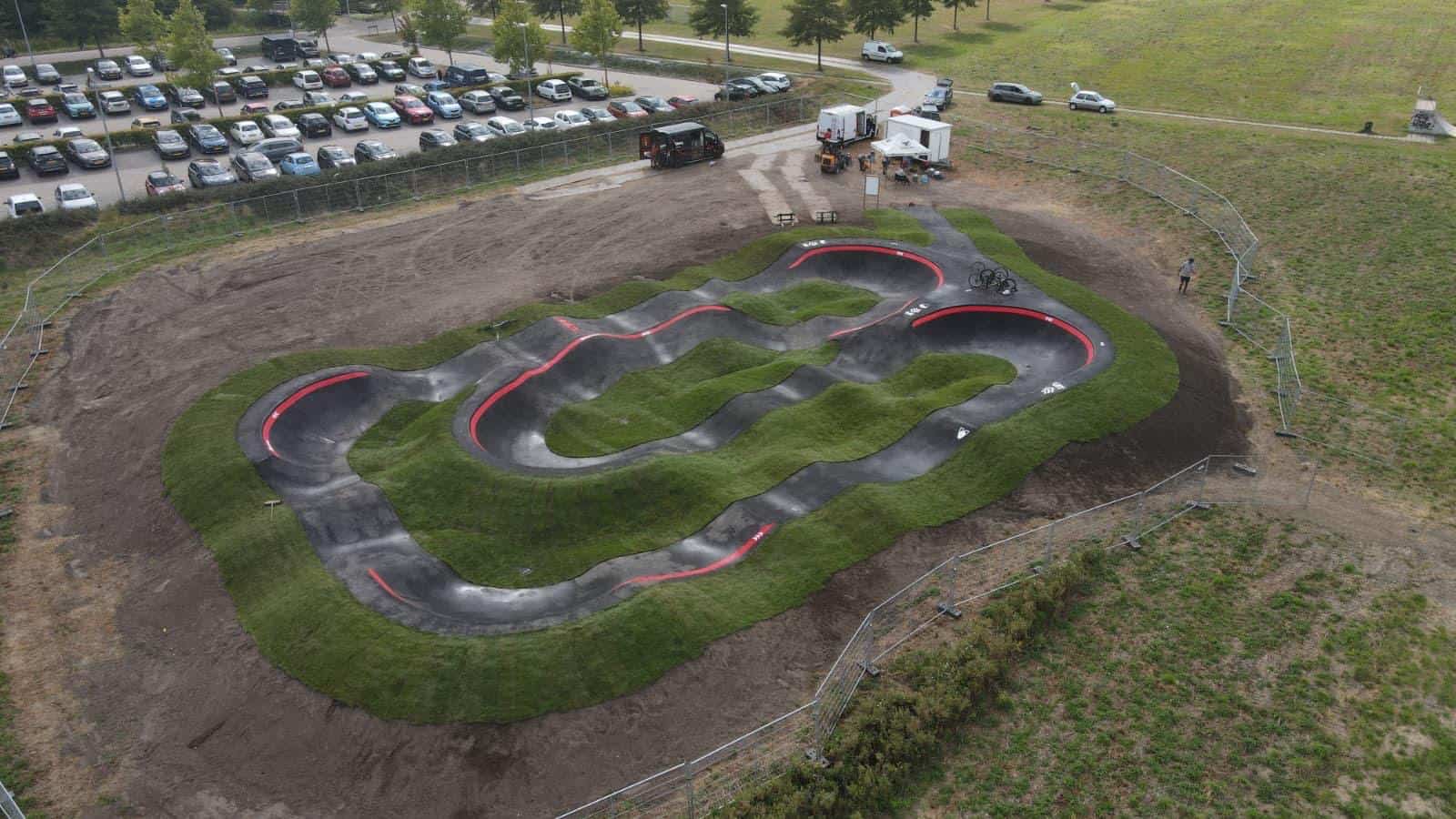
A PumpTrack has at least approximately 200 to 300 square meters needed to create a functional, rideable track. That is the absolute minimum requirement where you have enough room for a continuous loop with rollers and turns. The more space you have available, the more challenging and versatile the track becomes. In this article, we answer the most frequently asked questions about PumpTrack dimensions so you know exactly what is possible in your situation.
Which factors determine the space required for a PumpTrack?
The space required for a PumpTrack depends on four factors: the target audience. Then desired level of challenge. Then expected number of users simultaneously and the available shape of the terrainA track for young children on balance bikes can be smaller than a track for teenagers and adults on BMX or mountain bikes. The more people who want to ride at the same time, the longer the loop ideally should be.
In addition, the shape of the terrain plays a major role. A square or rectangular plot offers more design freedom than a narrow, elongated piece of land. A well-designed PumpTrack adapts to the available space, but there are limits to how compact a track can become without compromising the driving experience.
Finally, the type of use also matters. Do you want to combine the PumpTrack with other facilities, such as a playground or skatepark? Then it is smart to plan the entire space as an integrated zone rather than separate islands.
What is the absolute minimum surface area for a PumpTrack?
The absolute minimum surface area for a functional asphalt PumpTrack is around the 200 square metersOn that surface, you fit a closed loop with the basic components: rollers, one or two curves, and enough length to build and maintain speed. Smaller than this, it becomes difficult to design a rideable and safe track.
On 200 m², you can build an entry-level track that works perfectly for young children and beginners. The loop is short and the elements are modest in size, but the riding fun is certainly there. For a municipality or recreation park with limited space, this is a realistic option for creating an active sports facility.
Do you want more of a challenge and more driving experience? Then is 400 to 600 square meters the most commonly used format for an all-round PumpTrack that satisfies both beginners and advanced riders. On that surface, multiple riders can use the track at the same time without getting in each other's way.
Want to have an asphalt PumpTrack installed?
500+ tracks worldwide · UCI certified · 5-year warranty
How does the ideal PumpTrack size differ by target group?
The ideal PumpTrack size clearly differs by target group. For young children on balance bikes and small bikes, a smaller track with lower, gradual rollers suffices. For teenagers and adults on BMX, mountain bikes, skateboards, or scooters, larger elements and a longer loop are needed to provide enough speed and challenge.
Below you will find a general overview:
| Target audience | Recommended surface area | Features |
|---|---|---|
| Young children (balance bike, small bike) | 200 to 300 m² | Low rollers, gradual turns, short loop |
| Children and teenagers (bike, scooter, skateboard) | 300 to 500 m² | Average elements, medium loop |
| All-round (all ages, BMX, MTB) | 500 to 800 m² | Variation in height and rhythm, longer loop |
| Advanced and competition use | 800 m² and more | High rollers, complex line, multiple loops |
One of the big advantages of one asphalt Pump Track The advantage is that the design is always custom-made. This means that, within the available space, you can still create a track that suits the target group you want to serve, from toddlers on balance bikes to adults on BMX bikes.
How much space do you need for a PumpTrack on municipal grounds?
For a PumpTrack on municipal grounds, is 400 to 600 square meters A realistic and widely used starting point. On that scale, you build a track that serves multiple age groups and has enough capacity for daily use by local residents.
Municipalities often work with scarce land in parks, play areas, or public spaces. The good news is that a PumpTrack requires relatively little space compared to a football field or a traditional skatepark with the same number of users. Moreover, the track is accessible to anyone with wheels, from bicycles to skateboards to wheelchairs — even users of manual wheelchairs can use a PumpTrack without the need for a handbike — which greatly increases the utilization of the available square meters.
When planning the space, it is also wise to factor in a small buffer around the track for safety distances and potential benches or bicycle racks. Allow for an extra strip of for this. 1 to 2 meters around the driving surface. View our completed projects for a good idea of what this looks like in practice.
How much does a smaller PumpTrack cost compared to a larger one?
A smaller PumpTrack costs less than a larger one, but the price per square meter for a small track is usually higher. higher than with a larger one. This is because fixed costs for design, earthworks, transport, and certification remain the same, regardless of the size of the track.
A compact court of 200 to 300 m² therefore represents a lower total investment, but is less cost-efficient per user or per square meter than a medium-sized court. Municipalities wishing to calculate the total cost of ownership, including maintenance and lifespan, often find that a slightly larger court yields a higher return in the long term.
An asphalt PumpTrack goes at least 20 years included in regular maintenance. Velosolutions offers annual inspection and maintenance, which can also be purchased via a maintenance contract. Maintenance costs are low compared to wooden playground equipment or a grass football pitch. This makes the investment, even for a smaller court, easy to justify to a municipal council or budget holder.
Can a PumpTrack be expanded later if space is limited?
Yes, an asphalt Pump Track can often be expanded later. During the design phase, you can already account for future expansion by positioning the loop so that connection space remains on one or more sides. A well-designed entry track is therefore a first phase, not an endpoint.
Expansion can be done in two ways. You can extend the existing loop with extra rollers and curves, or add a second loop for a different level or target group. Both options are technically possible with asphalt, provided the subsurface and the connection are properly prepared.
Do you want to start now but know that demand will grow in the coming years? Then it is smart to consider expansion directions during the initial design phase. This prevents you from having to break up expensive asphalt later to make room. Separate drivable elements, also known as Velo Features mentioned are also a good way to flexibly expand an existing job without major intervention.
How Velosolutions helps determine the correct PumpTrack dimensions
At Velosolutions, we have been building custom PumpTracks for over 12 years, with more than 100 tracks completed in the Netherlands and active in over 35 countries worldwide. We know exactly what is possible on a small plot of land and the smartest way to utilize available space. Whether you have 200 m² or 1.000 m² available, we will work with you to determine the best design for your situation.
This is what we do for you:
- Free consultation about the possibilities at your location
- Custom design tailored to target group, space, and budget
- Full certification according to applicable standards and regulations
- Maintenance and warranty so that the course remains in top condition for years, including the option of a maintenance contract with annual inspection.
- Advice on expansion possibilities for the future
Wearing a helmet is mandatory on Velosolutions PumpTracks. Read more about us and discover how we work, or request a no-obligation consultation and tell us how much space you have available. We are happy to take a look with you.