Municipalities play a major role when it comes to outdoor play. They are responsible for public spaces, play policies, and the construction of playgrounds in neighborhoods and parks. In short: if your municipality takes outdoor play seriously, you will notice it immediately in the quality of the outdoor space around you. In this article, you will read what municipalities can do to encourage outdoor play, which facilities are appropriate, and what role residents play in this.
What is the responsibility of the municipality for outdoor play?
The municipality is responsible for constructing, maintaining, and managing public playgrounds. This stems from the municipal duty of care for public space and the well-being of residents. To this end, municipalities draw up a playground policy, which specifies how many and what types of playgrounds must be present in each neighborhood.
In addition to the physical design, safety is also a concern. Playground equipment must comply with legal standards, such as the Amusement and Playground Equipment Act (WAS)Municipalities are required to regularly inspect and maintain playgrounds. This is not only a legal requirement but also a matter of trust: parents and children must be able to count on a playground being safe.
Many municipalities work with a play area plan or environmental vision, in which they outline how they intend to design outdoor spaces for different age groups. This also describes how they address the aging population, inclusivity, and the need for movement-friendly spaces for both children and adults.
Why is playing outdoors so important for children and adults?
Playing outdoors is important for the physical and mental health of both children and adults. Exercising outdoors improves motor skills, strengthens the immune system, and reduces stress. For children, it is also a way to develop social skills and learn independence.
Children who play outside frequently move more on average than children who are primarily indoors. This has a positive effect on their concentration, sleep quality, and overall well-being. Outdoor play also stimulates creativity and problem-solving skills, because children have more freedom in the outdoor space than in a structured environment.
For adults, outdoor activities contribute to a more active lifestyle. A movement-friendly environment encourages people to go outside more often, whether for walking, cycling, or sports. Municipalities that invest in good outdoor spaces are thereby directly investing in the health of their residents.
Want to have an asphalt PumpTrack installed?
500+ tracks worldwide · UCI certified · 5-year warranty
How can a municipality actively encourage outdoor play?
A municipality can encourage outdoor play by investing in attractive, accessible, and challenging playgrounds in the immediate living environment of residents. The closer a playground is to home, the more often people use it. That sounds simple, but it requires well-thought-out policy.
Concrete steps that municipalities can take
- Distribution of playgrounds: Ensure that every neighborhood has a high-quality playground, not just in the city center or in large parks.
- Varied offer: offers play areas for various ages and levels, from toddlers to teenagers and adults.
- Accessibility: Make playgrounds wheelchair-friendly and suitable for children with disabilities.
- Multifunctional use: Choose facilities that can be used by multiple target groups at different times of the day.
- Maintenance and safety: Schedule regular inspections and ensure prompt repair if something is broken.
Municipalities that take outdoor play seriously also consider the surroundings of playgrounds. Sufficient greenery, good lighting, and safe accessibility make the difference between a place that is used and one that is not.
Which play facilities fit an active municipal policy?
An active municipal policy for outdoor play calls for play facilities that are challenging, sustainable, and suitable for multiple target groups. Examples include climbing frames, skateboarding facilities, exercise equipment for adults, and multifunctional sports areas. asphalt PumpTrack is a good example of such a multifunctional facility that is widely applicable.
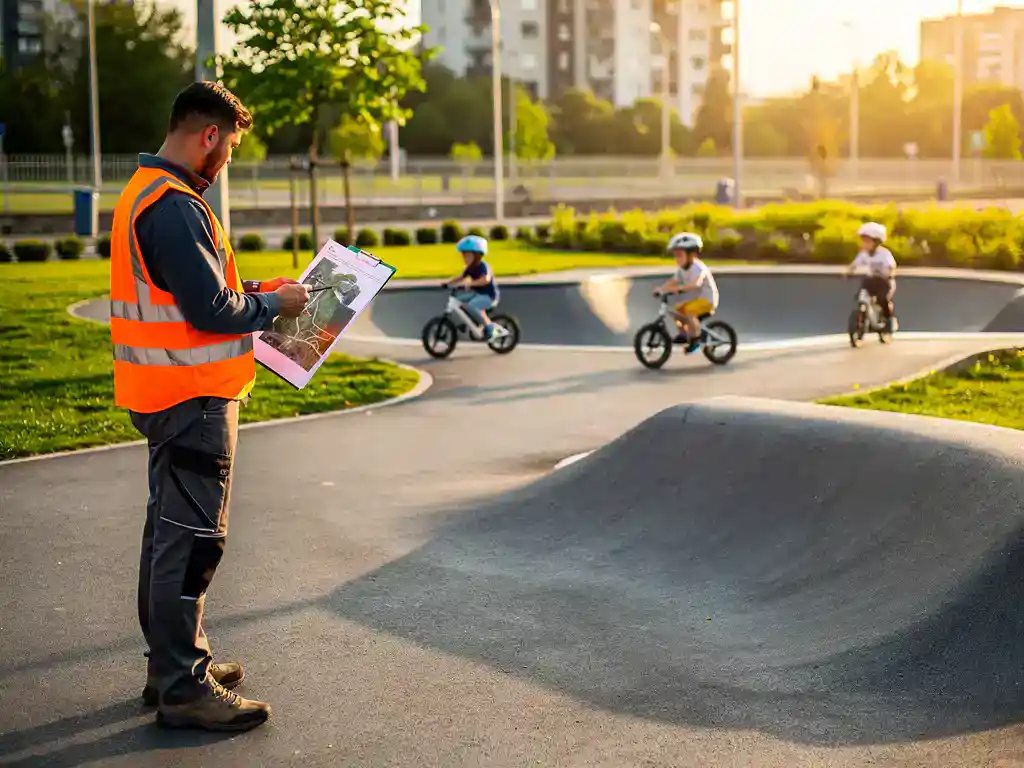
A PumpTrack is an undulating asphalt track where you move forward without pedaling by shifting your weight. The track features gradual curves and is suitable for balance bikes, BMXs, scooters, roller skates, and wheelchairs — including manual wheelchairs, for which no handbike is required. This makes it a unique facility: young and old, experienced and beginner; everyone can use it. Wearing a helmet is mandatory on Velosolutions PumpTracks.
Which target groups do you serve with a PumpTrack?
- Children from 2 years old on a balance bike
- Teenagers on a BMX or mountain bike
- Adults who want to exercise or coach their children
- People with a disability or in a (manual) wheelchair
In addition to PumpTracks, there are also exercise equipment for adults, nature playgrounds and skate parks are popular choices for municipalities that want to reach a broad audience. View our completed projects to see what is possible in various municipalities and neighborhoods.
What does it cost a municipality to install a PumpTrack?
The cost of installing a PumpTrack varies depending on the size, design, and location. A smaller PumpTrack for a neighborhood typically starts at a few tens of thousands of euros, while larger, professional tracks can cost more. The investment depends heavily on what you want to achieve and for whom.
Municipalities can look to various sources for funding. These include municipal budgets for sports and public space, but also subsidies from the province or the national government, funds such as the Sportakkoord or Fonds 1818, and contributions from local sponsors or housing corporations.
An important factor to consider in the cost assessment: an asphalt PumpTrack lasts at least 20 years and requires relatively little maintenance. This often makes the total investment over the years more cost-effective than you might initially think. Moreover, the societal return—more physical activity, more social interaction, and a livelier neighborhood—is difficult to quantify in monetary terms, but certainly worthwhile.
How do you involve residents in the plans for outdoor play areas?
You involve residents in plans for outdoor play areas by engaging them early in the process, actively consulting them, and taking their wishes seriously. Participation works best when it is concrete: not “what do you want?”, but “do you choose option A or B, and why?”
Resident participation in practice
There are various ways to involve residents:
- Information evenings or neighborhood meetings: Give residents the opportunity to ask questions and contribute ideas regarding the design.
- Online surveys: also reach people who cannot come to an evening.
- Children's panels or youth councils: Ask the end users directly about their wishes.
- Working groups per district: Give a small group of residents an active role in the planning process.
Residents who contribute ideas about their play area also feel more involved in its maintenance and use. They hold others accountable for respectful use and are quicker to report broken or unsafe items. Participation is therefore not only democratic; it simply works better.
How Velosolutions helps realize outdoor play spaces for municipalities
At Velosolutions, we help municipalities from A to Z in realizing high-quality, sustainable outdoor play areas. Whether you are just starting to think about a new play space or already have a concrete plan, we are happy to brainstorm with you.
- We design custom PumpTracks, tailored to the location, the target audience, and the available budget.
- We oversee the entire process: from the initial design to delivery and the annual inspection. Annual inspection and maintenance can also be purchased via a maintenance contract.
- Our PumpTracks comply with the WAS and are supplied with a NEN-EN 14974 certificate.
- We have over 10 years of experience and have installed more than 500 PumpTracks worldwide.
- We help explore financing options and participation processes with residents.
Read more about who we are and what drives us. Would you like to know what we can do for your municipality? Request a no-obligation consultation and we would be happy to tell you more.