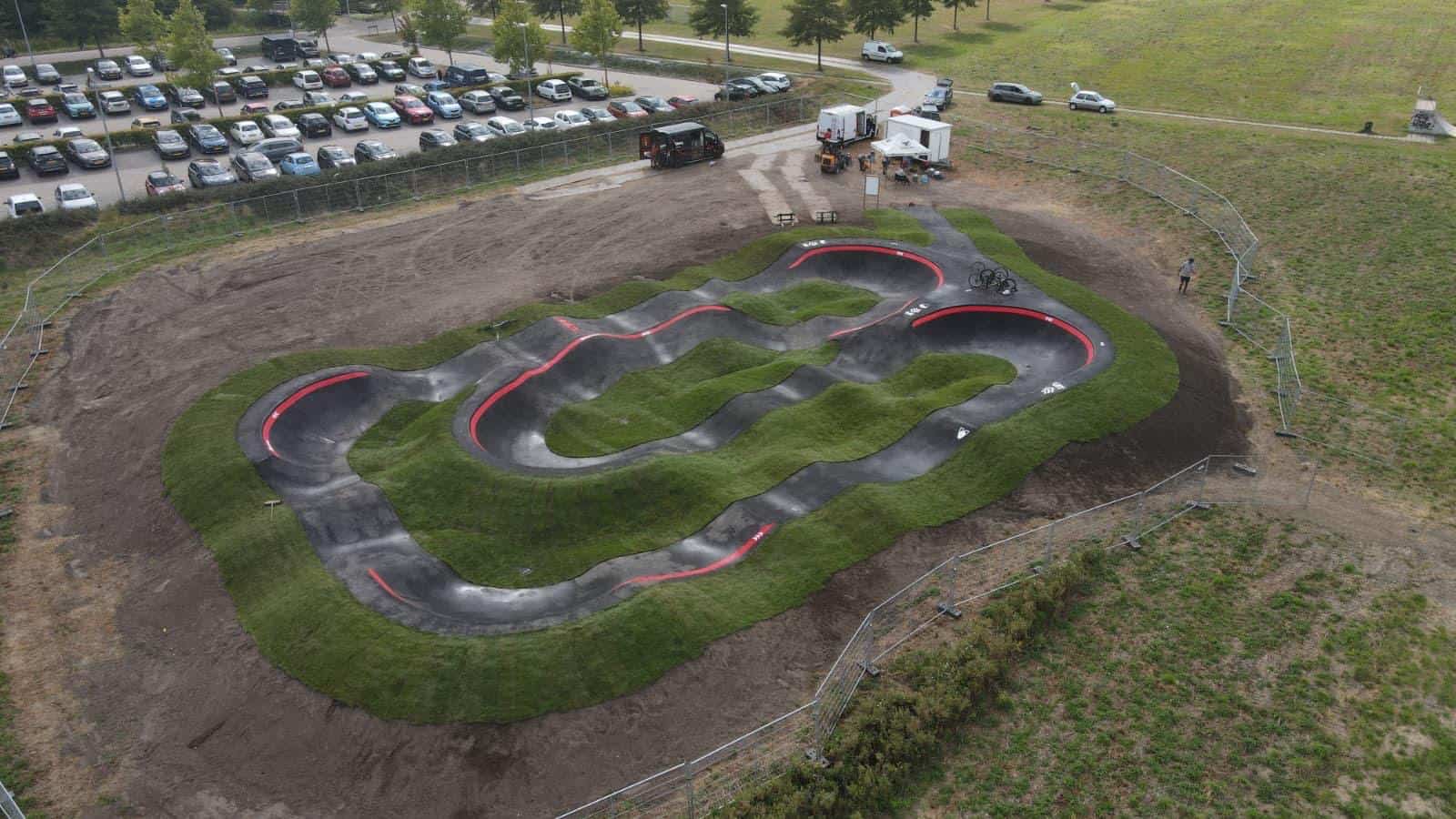
Building a PumpTrack for your municipality involves five steps: determining the location, applying for permits, having a design created, constructing the track, and organizing management. The entire process takes an average of six to twelve months, depending on the permit procedure and the size of the project. In this article, we answer the most frequently asked questions about realizing a PumpTrack, from budget to resident participation.
How much budget does a municipality need for a PumpTrack?
For a asphalt PumpTrack A municipality charges an average of between 60.000 and 150.000 euros, depending on the size, design, and site conditions. A smaller entry-level track of approximately 200 square meters is at the lower end of this spectrum. A larger, more extensive track with more rollers and curves is at the upper end.
In addition to construction costs, there are also costs for ground preparation, potential fencing, lighting, and permit applications. Add annual maintenance to that: this is relatively reasonable for asphalt, especially compared to wooden playground equipment, which wears out faster and needs to be replaced more often.
What makes a PumpTrack financially attractive is the long lifespan of at least 20 years and the wide range of uses. One facility serves preschoolers on balance bikes, teenagers on BMX bikes, and adults on mountain bikes. If you divide the costs by the number of users over the entire lifespan, the investment per user is low compared to traditional playgrounds or skate parks, which appeal to a much narrower target group.
Tip: also look into subsidies through the National Sports Agreement, provincial sports funds, or local funds for outdoor sports and health promotion. Many municipalities finance part of the construction through these types of schemes.
Which permits are required to install a PumpTrack?
To install a PumpTrack, in most cases you need a environmental permit necessary, especially if the course is constructed in a park or public area. In addition, the course must comply with the Dutch Amusement and Playground Equipment Act (WAS) and be built in accordance with standard NEN-EN14974.
WAS legislation sets requirements for the safety of public playground equipment and attractions. A PumpTrack falls under this law as soon as it is accessible to the public. This means that the track must be designed, built, and inspected by a recognized party, and that a valid inspection report must be available.
In practical terms, as a municipality, you go through these steps:
- Check zoning plan: is a sports facility permitted at the intended location?
- Apply for an environmental permit with the municipality itself (or coordinate internally).
- Have it built by a party that works according to WAS and NEN-EN14974.
- After delivery: carry out the official inspection and receive the inspection report.
A good contractor arranges the inspection as part of the overall process, so that you, as a municipality, do not have to figure out exactly which standards the track must meet yourself.
Want to have an asphalt PumpTrack installed?
500+ tracks worldwide · UCI certified · 5-year warranty
How long does it take to build a PumpTrack?
The actual construction of an asphalt PumpTrack takes usually one to two weeksHowever, the entire process from initial idea to opening takes an average of six to twelve months, with the permitting procedure taking up the most time.
A global timeline looks like this:
- Months 1 to 2: Location selection, initial design, and internal agreement.
- Months 2 to 5: Permit application and processing time procedure.
- Months 5 to 6: Final design and tendering.
- Months 6 to 7: Earthworks and asphalt laying.
- Month 7: Inspection and opening.
The construction time itself is short because the asphalt is processed and cooled quickly. Specialists finish the track manually, creating the flowing shapes that give a PumpTrack its character. After a few days of drying, the track is ready for use.
What are the maintenance requirements of an asphalt PumpTrack?
Create a Asphalt PumpTrack requires little maintenance. compared to other sports facilities. Annual inspection and limited maintenance are generally sufficient to keep the track in good condition for its entire lifespan of at least 20 years.
As a material, asphalt is more durable than wood or concrete for this type of application. It wears evenly, has no loose parts that can break or weather, and is resistant to varying weather conditions. Small cracks or wear in the top layer are easy to repair without replacing the entire surface.
What you, as a municipality, need to pay attention to:
- Annual visual inspection for cracks, subsidence, or damage.
- Periodically clear leaves and dirt so that the track does not become slippery.
- Perform minor repairs in a timely manner to prevent greater damage.
- Check whether the track still meets the WAS inspection requirements.
Velosolutions offers annual inspection and maintenance for all PumpTracks they install. Many municipalities opt for a maintenance contract, so that annual inspections and minor repairs are automatically scheduled. This provides certainty and prevents maintenance from being neglected.
Which location is suitable for a PumpTrack in a municipality?
A good location for a PumpTrack is a flat or slightly sloping terrain of at least 300 to 500 square meters, preferably near existing sports or play facilities. Think of a park, schoolyard, sports park, or neighborhood square.
Several factors play a role in the choice of location:
- Opening hours office The PumpTrack must be easily accessible to the target group, preferably within cycling distance of residential areas.
- Visibility: A visible location encourages spontaneous use and social control.
- Substrate: The soil must be stable enough for an asphalt foundation. This is investigated in advance.
- Surroundings: Take local residents into account. A PumpTrack makes noise, but much less than a skatepark with metal obstacles.
- Room for growth: Choose a location where expansion is potentially possible if popularity increases.
A location next to a asphalt PumpTrack Combining it with existing green areas or playgrounds works well. This way, you make optimal use of the available space and immediately attract a broader group of visitors.
How do you involve residents in the construction of a PumpTrack?
Resident participation increases support, provides valuable input for the design, and ensures that the PumpTrack truly aligns with the wishes of the neighborhood. Start early in the process communicate and involve residents in the location selection from the start.
Practical ways to involve residents:
- Information evening or walk-in session: Present the plan and give residents the opportunity to ask questions and contribute ideas.
- Online survey: Ask residents about their preferences regarding location, size, and target group.
- Sounding board group: Involve a small group of enthusiastic residents in the further process.
- Communicate via neighborhood channels: Use the municipal newsletter, social media, or a neighborhood app to keep everyone informed.
Many successful PumpTracks originated from a citizens' initiative: residents who themselves proposed the idea to the municipality. View our completed projects to see how other municipalities have gone through this process and what the results are.
Also involve future users directly: children, teenagers, and sporty adults. Their input regarding the desired difficulty level and the layout of the course is valuable for the design.
How Velosolutions helps build a PumpTrack for your municipality
We guide municipalities from the initial idea through to the official opening and everything that follows. As the market leader in the Netherlands with over 100 completed PumpTracks and 12 years of experience, we know exactly the challenges municipalities face: from permit applications to resident participation, and from budget planning to inspections.
What we arrange for you:
- Location advice and feasibility check.
- Custom-made design, tailored to the available space and target group.
- Complete installation by specialists with manual laying of the asphalt.
- Inspection according to WAS and NEN-EN14974, including official inspection report.
- 5-year warranty on the track and annual maintenance contract.
- Support with resident participation and communication.
Wearing a helmet is mandatory on Velosolutions PumpTracks. Our PumpTracks are suitable for anyone with wheels: from toddlers on balance bikes to adults on BMX bikes, skateboards, scooters, or inline skates. Users of manual wheelchairs can also use a PumpTrack — a handbike is not necessary for this. This makes a PumpTrack one of the broadest and most inclusive sports facilities a municipality can install on a relatively small plot of land.
Discover who we are and read more about our approach, or request a no-obligation consultation to discuss what is possible for your municipality.