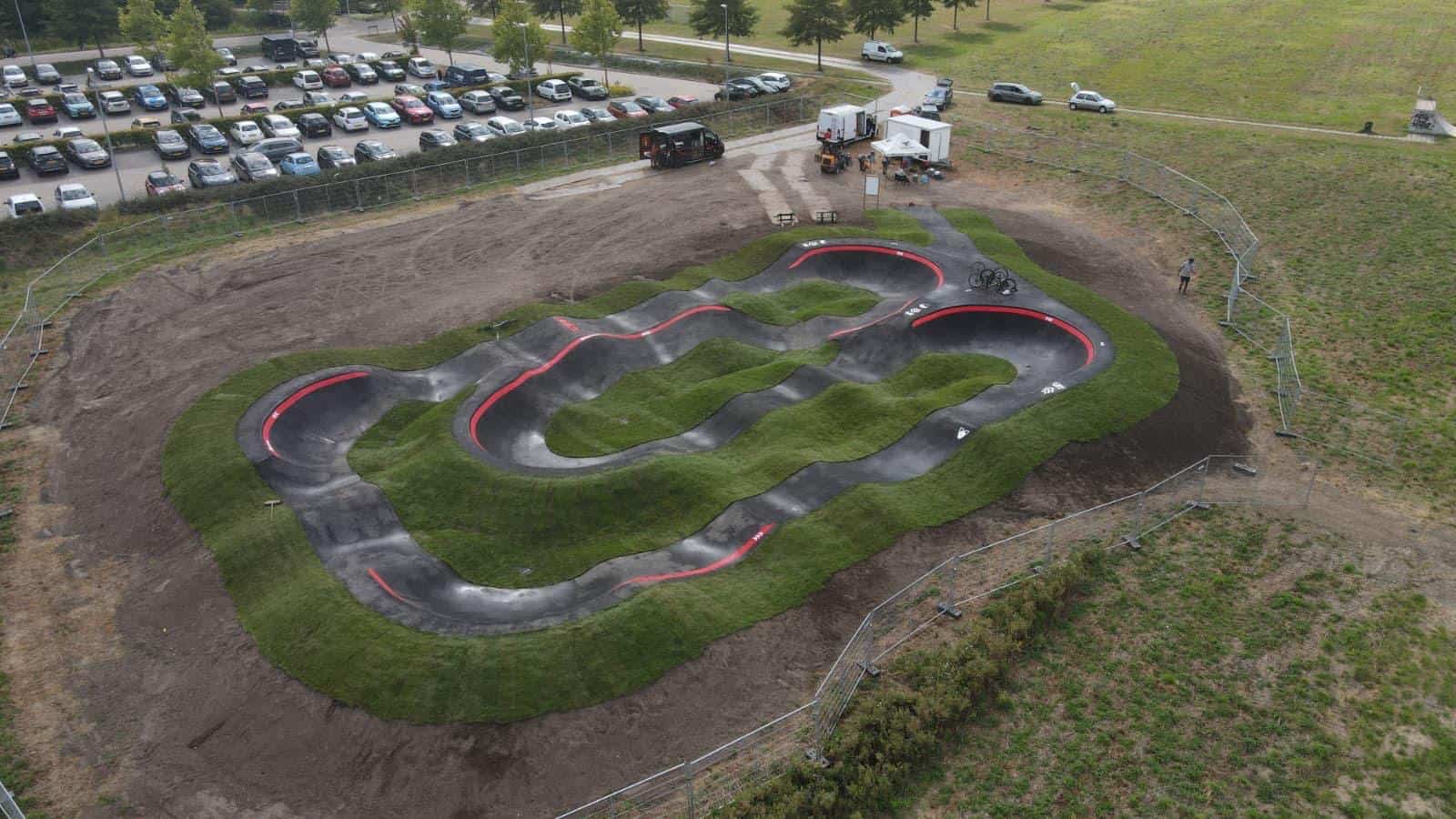
A location is suitable for a PumpTrack if at least 400 to 600 square meters are available, the subsoil is stable and permeable enough to lay asphalt on, and the site is easily accessible to the target group. For an asphalt PumpTrack, you also need a flat or slightly sloping surface, free of obstacles such as cables, trees, or sewers. In this article, we answer the most frequently asked questions about site selection so that you know what to look out for before you put even a single shovel in the ground.
How much space do you need for a PumpTrack?
For a full-fledged asphalt PumpTrack, you need at least 400 to 600 square meters. That sounds like a lot, but it is comparable to a small basketball court. A compact track of 200 to 300 square meters is technically possible, but offers less riding fun and attracts fewer users. The larger the track, the more variety and the more attractive the facility.
What many people do not realize is that the shape of the terrain is at least as important as the surface area. An elongated strip of ten by forty meters works much less well than a more square or rectangular space. A PumpTrack consists of continuous curves and hills that form a circular circuit, and that requires a specific ratio of width to length.
Also take the following into account when calculating the space:
- Security zone around the track (at least 1,5 to 2 meters on all sides)
- Space for a starting point or entry point
- Optionally a seating area or spectator area
- Accessibility for maintenance and inspection
Create a asphalt PumpTrack It is always custom-designed, so the exact dimensions are tailored to the available space. This makes it possible to create a good design even in challenging locations.
Which surface is suitable for an asphalt PumpTrack?
The ideal subbase for an asphalt PumpTrack is a stable, load-bearing soil that can be well compacted. Sandy soil, clay, and mixed soil types are perfectly suitable in most cases, provided the soil has sufficient load-bearing capacity. Existing paving such as concrete or tiles can also serve as a base, but this requires additional assessment.
What you want to avoid is a subsoil that moves or subsides too much, such as peat soil or areas with a high groundwater level. Over time, these can cause cracks in the asphalt, which shortens the lifespan of the track.
As a material, asphalt has major advantages over wood or concrete. It is more flexible, meaning that minor movements in the ground are less likely to become visible as damage. Moreover, asphalt is easy to maintain: minor damage is relatively easy to repair. This contributes to a lifespan of at least 20 years, making asphalt one of the most sustainable choices for outdoor sports facilities.
Want to have an asphalt PumpTrack installed?
500+ tracks worldwide · UCI certified · 5-year warranty
Where is the best place to place a PumpTrack on a site?
The best place for a PumpTrack is a location that clearly visible and easily accessible is, preferably near other sports facilities or playgrounds. Visibility encourages use: if people see the track as they walk or cycle past, the threshold to stop and ride is much lower.
Practical considerations when choosing the location:
- Proximity to the target group: a residential area, school, or sports park nearby significantly increases usage
- Social safety: a location that is visible from the surroundings provides a safer feeling
- No excessive shadeTrees and buildings can keep the surface damp, which affects ride quality and lifespan.
- No cables or pipes in the soil: this is one of the most common surprises during construction
- Accessibility for maintenance: ensure there is access for a machine or vehicle during annual maintenance
Do you want to know how other municipalities and recreation parks chose their location? View our completed projects for inspiration and practical examples.
What permits are required for a PumpTrack?
For most asphalt PumpTracks, a environmental permit necessary, but that depends on the municipality and the exact location. In many cases, a PumpTrack falls under the category of structures for which a permit must be applied for, especially if earthworks are involved or the height of the track exceeds a certain threshold.
In addition to the environmental permit, there is also the WAS legislation: the Dutch Amusement and Playground Equipment Act. An asphalt PumpTrack accessible to the public falls under this act and must comply with the NEN-EN 14974 standard. This means that the track must be certified by a recognized inspector before it is put into use. Without that certificate, the PumpTrack may not be formally opened.
This sounds complicated, but in practice, it is easy to arrange if you factor this into the planning in advance. It is wise to run the permit procedure and certification in parallel with the design process so that you do not experience delays upon completion.
What are common mistakes when choosing a location?
The most common mistake is choosing a location based on availability rather than suitability. A plot of land is free, so it is designated for the PumpTrack. But if that land is too small, too shaded, or full of cables and pipes, you end up paying more and getting less.
Other common mistakes:
- Reserving too little space for the safety zone around the track
- No KLIC notification to check cables and pipes in the ground
- Involving local residents too late, which can lead to objections or delays in the permit process
- Do not take water drainage into account: if rainwater does not drain properly, the surface can become slippery and dangerous
- Do not test the location for load-bearing capacity before the design becomes final
All these errors can be prevented with good preparation and a site check before the design is created.
How do you know for sure that a location is really suitable?
You know for sure that a location is suitable if there is a location research has been done, whereby soil conditions, dimensions, accessibility, cables and pipelines, and legal restrictions have been checked. Only if all these points turn out positively is it responsible to have a design drawn up and to apply for a permit.
In practice, such a location check consists of a combination of:
- A measurement of the available surface area and the shape of the terrain
- A KLIC notification to map cables and pipelines
- An assessment of soil conditions and bearing capacity
- A check on the zoning plan and any restrictions
- An inventory of environmental factors such as shade, water drainage, and social safety
Only when all these steps have been completed will you have the certainty you need to take the next step. Good news: you don't have to figure all of this out yourself.
How Velosolutions helps assess your location
At Velosolutions, we guide municipalities and recreation parks not only through the construction of a PumpTrack, but also through everything leading up to it. We assess the location together, help determine the best spot on the site, and check whether the soil and dimensions are suitable for an asphalt PumpTrack. With over 100 PumpTracks built in the Netherlands and 12 years of experience as a market leader, we know exactly what to look out for.
What we do for you:
- Site check including assessment of soil, space, and environmental factors
- Custom-made design that fits within the available space
- Guidance during the permit process and WAS certification
- Annual inspection and maintenance after delivery, also available via a maintenance contract, and a 5-year warranty.
- Concrete references from similar projects in other municipalities and parks
Read more about us and discover how we have been building PumpTracks that are actually used for over ten years. Or request a no-obligation consultation and we check together if your location is suitable for building a PumpTrack.